Let’s be honest: sourcing appliances from around the world can be daunting. With thousands of suppliers online, it’s easy to choose a partner based solely on attractive product photos and an extremely low price. However, in hardware manufacturing, cutting corners can have disastrous consequences. Selecting the wrong partner can result in more than just delayed shipments; it can lead to failed safety tests, seized container loads at customs, catastrophic product recalls and a ruined brand reputation that took years to build.
To protect your investment and safely scale your business, you need to look beyond basic sales pitches and evaluate factories as a seasoned procurement expert would. Read on for the five costly mistakes to avoid when choosing a kitchen appliance manufacturer, along with practical advice to ensure the success of your next sourcing project.
Mistake 1: Prioritizing the Lowest Price Over Total Sourcing Costs
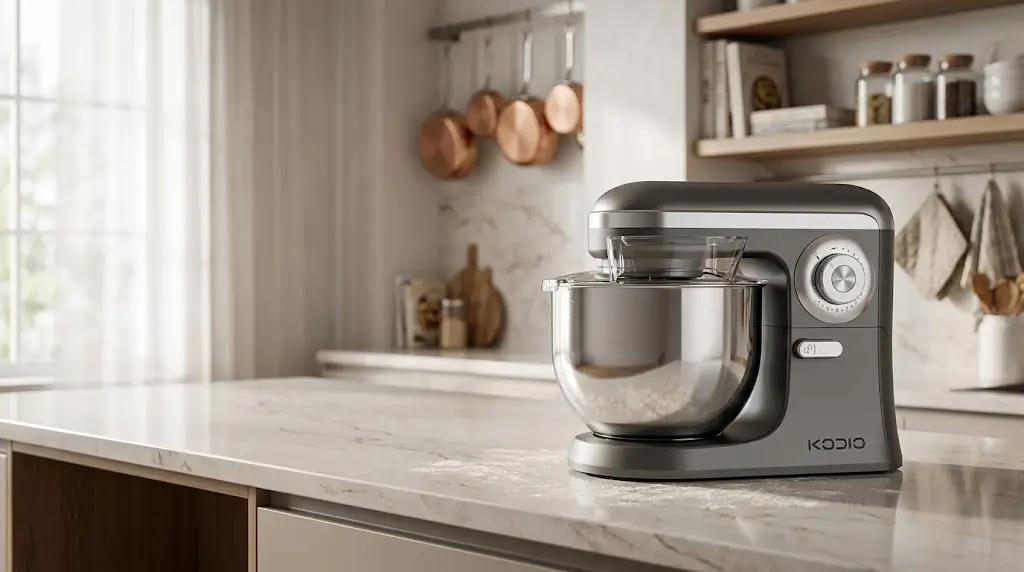
Seeking the highest possible profit margins is a natural business instinct. When reviewing production quotes for electronic items such as meat grinders, juice extractors, and digital air fryers, it can be tempting to choose the supplier offering the lowest per-unit cost (free on board, or FOB). However, there is an absolute, unbreakable law in the manufacturing industry: you get what you pay for. If a factory offers a price that is significantly lower than the market average, it is not out of the goodness of their heart. They are doing so by compromising on internal engineering, material purity, and structural integrity.
The Hidden Danger of Substandard Components
Small kitchen appliances operate under demanding conditions, involving high electrical currents, intense heat, and high-torque mechanical rotation. To lower costs, a sub-standard supplier will often make critical material substitutions:
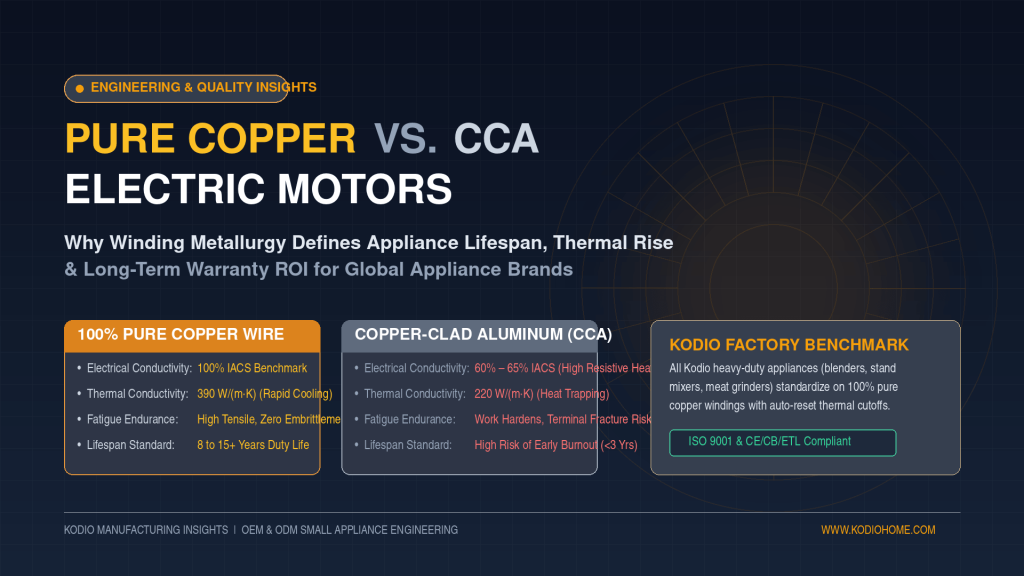
- The Motor: They might swap out a heavy-duty, pure copper motor for a cheaper 7620 CCA (Copper Clad Aluminum) motor or a low-grade aluminum wire motor without notifying you. While a CCA motor can be engineered safely by a premium manufacturer to meet specific rated power targets (e.g., 400W–800W) with proper thermal insulation, a low-end factory will simply use thinner, low-grade wiring that overheats rapidly under a heavy workload.
- The Plastics: They may utilize recycled plastic scrap or non-food-grade ABS/PP polymers for the appliance housing and food-contact areas. These plastics degrade quickly, warp under thermal stress, emit toxic chemical odors, and break easily during international transit.
- Internal Circuitry: Low-cost factories cut corners on internal components like PCBs, thermal fuses, and power cords. Skipping proper surge protection or using non-certified wiring increases the risk of electrical shorts and fires.
Calculating the True Cost of Sourcing
For example, if you buy 2,000 units of a wholesale kitchen appliance model for $15 per unit from a premium manufacturer instead of $18, you might think you have just saved $6,000.
However, if that cheaper batch arrives with an 8% defect rate instead of the standard 0.5%, the maths changes drastically. You would face thousands of dollars’ worth of unsellable inventory, expensive return logistics, Amazon account suspensions due to negative customer reviews, and hours of customer service headaches.
Actionable Advice for Smart Buyers
Never evaluate a quote in isolation. Always ask for a detailed bill of materials (BOM) breakdown. When sourcing wholesale kitchen appliances, request pre-production samples and have them subjected to extreme stress tests in an independent laboratory. Evaluate your suppliers based on the total cost of ownership (TCO), which includes production, shipping, customs clearance, defect management, and after-sales spare parts, rather than just the initial free on board (FOB) price.
Mistake 2: Ignoring Regional Compliance and Safety Certifications
Sourcing household electronics is completely different from sourcing textiles, toys or non-electrical consumer goods. Kitchen appliances are high-power devices that handle food preparation, so they are heavily regulated by international governments to ensure consumer safety and prevent fire hazards.
One of the most costly mistakes an importer can make is assuming that, just because a factory claims its products are high-end kitchen appliances, they are automatically legally compliant in your target market.
The Landscape of Global Regulatory Standards
Different regions require completely different sets of certifications. If your retail store or distribution business is located in North America, Europe, or the Middle East, your inventory must clear strict customs hurdles and pass domestic market surveillance audits:
| Target Region | Essential Mandatory & Voluntary Safety Certifications |
| Europe (EU) | CE (Conformité Européenne), GS (Geprüfte Sicherheit for German safety), RoHS (Restriction of Hazardous Substances), and CB schemes. |
| North America (US & Canada) | ETL or UL (Underwriters Laboratories) listings, alongside FCC compliance for electromagnetic interference. |
| Middle East (e.g., Saudi Arabia, UAE) | G-Mark (Gulf Conformity Mark) and specific country-level SASO/ESMA registrations. |
| International / Global | CB Test Certificates (IEC standards), which act as a universal passport to convert into local country-level certifications. |
The Consequences of Non-Compliance
If you partner with an unverified kitchen appliance manufacturer that lacks these authentic test reports, the consequences are severe:
- Customs Seizures: Customs border protection officers routinely inspect incoming shipments of electrical products. If the proper CE, GS, or ETL paperwork is missing, incomplete, or forged, your entire container will be permanently confiscated or sent back at your expense.
- Retail Bans and Fines: If you manage to slip uncertified products into your market, domestic consumer protection agencies can issue massive corporate fines, force you to pull the items from retail shelves, and mandate a public product recall.
- Insurance Denial: If an uncertified appliance causes an electrical fire in a consumer’s home, your commercial liability insurance policy will likely be voided because you distributed non-compliant merchandise.
How to Verify Factory Compliance
A professional kitchen appliance manufacturer in China will always have a robust library of valid, unexpired test reports issued by internationally recognised third-party testing laboratories such as SGS, TÜV Rheinland, Intertek or Bureau Veritas.
When a supplier sends you a certificate, don’t just look at the PDF. Take the certificate number and go directly to the database website of the issuing testing agency (e.g. the online certificate directories of TÜV or Intertek) to verify that the factory name, model number and validity dates are an exact match.
Furthermore, ensure that the factory can customise the electrical hardware layout to your local grid infrastructure, whether that requires a 110–120 V configuration with a US Type N plug for South American subregions or a 220–240 V setup with a UK/EU BS plug for Middle Eastern markets.
Mistake 3: Overlooking R&D and Customization (OEM/ODM) Capabilities
To thrive in today’s fiercely competitive retail environment, you cannot sell the same generic items as hundreds of other stores that are sourced from public trading companies. Consumer preferences shift rapidly and markets become saturated easily.
One mistake that many brands make is choosing a supplier that merely functions as an assembly shop and lacks independent research and development (R&D) and engineering capabilities.
Trading Companies vs. R&D-Driven Factories
Many online storefronts claim to be direct factories, but are actually small trading entities. These middlemen have no control over product design. They source cheap, mass-produced components from various workshops and assemble them. If you request a modification to a custom kitchen appliance design—such as modifying the internal gearbox for higher torque, altering the housing ergonomics, or designing a bespoke digital control panel—these trading companies will simply tell you it’s impossible.
To build a sustainable private label brand, you need a kitchen appliance manufacturer that treats R&D as a core pillar of its infrastructure.
The Power of In-House Tooling and Mold Making
A premium manufacturer controls the entire production lifecycle. They possess their own state-of-the-art mold-making (tooling) workshops and plastic injection molding facilities. This infrastructure delivers massive advantages for your brand:
- True Customization: They can easily provide comprehensive OEM and ODM services. Whether you need a custom brand logo stamped permanently onto the chassis, a specialised injection-coloured ABS exterior shell to match your brand’s colour palette or entirely new aesthetic curves, a factory focused on engineering can implement changes smoothly.
- Continuous Product Innovation: Leading kitchen appliance manufacturers in China consistently launch between 5 and 10 completely new, patented product designs every single year. Partnering with an innovative manufacturer guarantees that your store will always have first-choice access to next-generation kitchen gadgets, keeping your brand steps ahead of the competition.
- Packaging and Brand Identity Support: A full-service manufacturer doesn’t just hand over a bare appliance; they feature internal graphic design teams capable of constructing your retail gift boxes, user manuals, and container loading layouts from scratch, ensuring a premium unboxing experience for your consumers.
Mistake 4: Failing to Verify Supply Chain Stability and Lead Time
In retail and wholesale, time is money. A beautiful product with great margins is useless if it arrives at your warehouse two months after your peak selling season ends. Many importers fall victim to suppliers who make grand promises about rapid production times during negotiations, only to cause severe delays once the deposit has been paid.
Such unreliable production lead times are usually indicative of underlying supply chain issues within the factory itself.
The Vulnerability of Small Workshops
Smaller, unverified factories do not have long-term contracts with raw material suppliers. They buy steel, copper, plastics, and electronic microchips on the open spot market only after you place an order. If the global market experiences a sudden shortage of microchips or an inflationary spike in raw material prices, these small workshops will halt your production entirely, trying to wait out the market fluctuations or demanding that you pay a higher price mid-contract.
Evaluating Factory Infrastructure for Stable Deliveries
When auditing a prospective kitchen appliance manufacturer, you must look deeply into their physical operational scale and supply chain management systems. A world-class manufacturing hub must possess:
- Sufficient Physical Footprint and Production Lines: Look for factories that operate massive, modern manufacturing facilities (e.g., 30,000㎡ to 50,000㎡) equipped with 6 or more semi-automatic production assembly lines. This ensures they have the physical capacity to scale up production when your order volume surges.
- Strategic Raw Material Stockpiling: A financially stable manufacturer maintains a massive buffer inventory of critical electronic chipsets, heating elements, and premium raw materials. This strategic buffer insulates your production schedule from unexpected global supply chain disruptions and volatile price shocks.
- Rigorous Internal Quality Workflows: Fast delivery is meaningless if the goods are defective. A premium factory integrates quality check stations directly into the assembly line. These include Incoming Quality Control (IQC) for checking incoming raw materials, In-Process Quality Control (IPQC) on active assembly lines and Final Quality Control (FQC) in a dedicated testing workshop. Here, every appliance undergoes high-voltage insulation tests, thermal cut-off evaluations and lifespan runtime stress checks before container loading.
Mistake 5: Neglecting Intellectual Property (IP) Protection & NDAs
Imagine spending months researching your local market, collaborating with an engineer to modify a line of high-end kitchen appliances, designing a beautiful retail box and investing thousands of dollars in a custom product mould. You place your initial order, launch the product in your market and it becomes an instant bestseller.
Six months later, however, you discover that five of your direct competitors are selling the same product design using your custom mould and undercutting your retail price.
How did this happen? It happened because you neglected to legally secure your intellectual property with your manufacturer before entering production.
The Misconception About Offshore Hardware Sourcing
Many buyers assume that manufacturing agreements signed across international borders are unenforceable or that factories will naturally maintain confidentiality out of goodwill. This is a naive assumption. In the hyper-competitive world of hardware manufacturing, if a custom design or unique product modification is not bound by a bulletproof legal framework, unscrupulous suppliers will see it as a free product development opportunity to market to other international buyers.
Securing Your Brand with a Legal Framework
Before you share a single engineering blueprint, CAD file, product sketch, or specific component adjustment with a kitchen appliance manufacturer, you must establish a rigorous legal boundary:
- The Non-Disclosure, Non-Use, and Non-Circumvention Agreement (NNN / NDA): Do not use a generic, single-page NDA downloaded from the internet. You must implement a comprehensive B2B manufacturing agreement that explicitly states the factory cannot use your custom molds, proprietary designs, or brand intellectual property to manufacture products for any other entity in the world without your express written consent.
- Exclusive Tooling Ownership: Your production contract must state explicitly that you maintain 100% legal ownership of any custom injection molds or tooling components that you have paid for, and that the factory is merely leasing those molds to fulfill your specific purchase orders.
A reputable, premium OEM/ODM factory will never hesitate to sign a strict NNN or NDA agreement. They value long-term partnerships, brand integrity, and international legal compliance just as much as you do. If a supplier makes excuses or hesitates to sign a formal confidentiality agreement before a project begins, walk away immediately—no matter how attractive their pricing appears.
To save you time and help you bypass these sourcing risks altogether, we’ve analyzed the market leaders for you. Explore our curated list of the [Top 10 Kitchen Appliances Manufacturers in China: The Ultimate 2026 Buying Guide]
Conclusion: Partnering for Long-Term Sourcing Success
Sourcing premium consumer electronics requires striking the right balance between price, quality, compliance and legal security. Avoiding the following five critical mistakes will protect your business capital and lay the foundation for explosive retail growth: refusing to chase the lowest unsustainable price; meticulously verifying regional certificates; prioritising R&D-driven OEM/ODM factories; auditing supply chain stability; and legally locking down your intellectual property.
If you are looking for a verified tier-one kitchen appliance manufacturer that ticks all the boxes, Kodio (Guangzhou Chamd Household Appliances Limited) is your ultimate global production partner. Founded in 2009, we have a 45,000 m² state-of-the-art manufacturing facility in Guangzhou, China, supported by over 500 skilled workers and six high-efficiency semi-automatic production lines.
At Kodio, we eliminate the stress of international sourcing by offering:
- Comprehensive Certifications: Our entire manufacturing workflow is standardized, and our products carry valid global compliance certifications, including CE, GS, CB, ETL, and RoHS for immediate market access.
- Full-Scale In-House R&D: Equipped with our own advanced tooling and plastic injection molding workshops, our engineering team launches 5–10 innovative designs every year and provides deep custom kitchen appliances OEM/ODM support tailored to your brand goals.
- Unmatched Supply Chain Stability: We maintain extensive buffer inventories of critical microchips and premium raw materials, ensuring highly reliable 30-45 day lead times and ironclad quality control.
- Absolute IP Security: We strictly sign and uphold formal NDAs/NNN agreements to ensure your custom proprietary molds and designs remain exclusively yours.
Don’t leave your brand’s supply chain to chance. Contact our expert team today to discuss your next custom project, request certified product samples, and secure a comprehensive 24-hour manufacturing quote!