You have found a small appliance that fits your target market, reviewed the samples, and are ready to discuss your first order. Then the manufacturer gives you an MOQ that is higher than the quantity you planned to buy.
For a new brand, importer, or distributor, this can create a difficult decision. Ordering too many units may tie up cash and increase inventory risk. Ordering too few may make production uneconomical or prevent the manufacturer from sourcing certain customized components.
So, what actually affects MOQ in small appliance manufacturing?
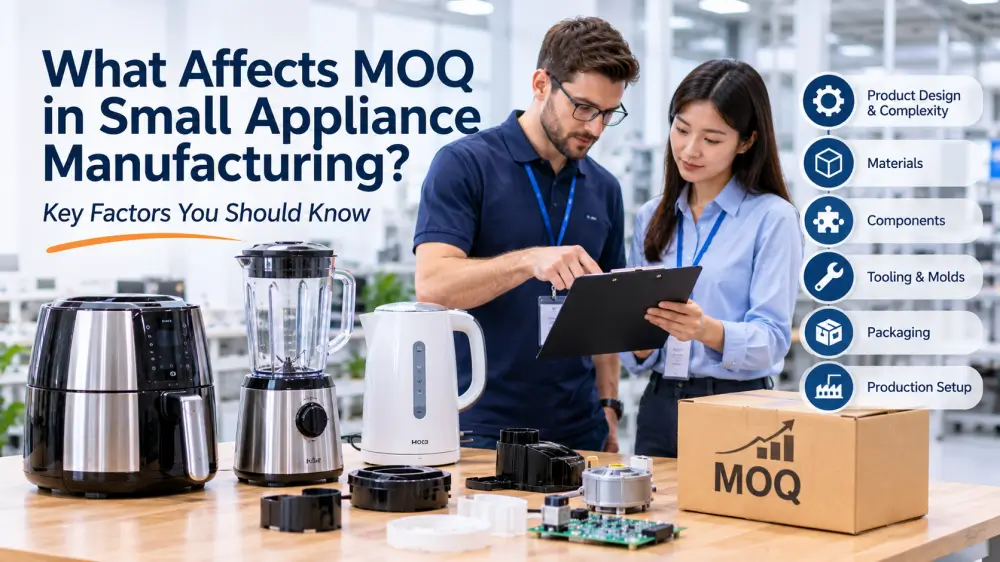
MOQ, or Minimum Order Quantity, is influenced by more than the factory’s production capacity. Product design, customization, component suppliers, raw materials, packaging, tooling, and production setup can all affect the minimum quantity a manufacturer can accept.
Understanding these factors helps buyers identify which requirements are flexible, compare supplier quotations more accurately, and plan a more realistic first order.
What Is MOQ in Small Appliance Manufacturing?
MOQ stands for Minimum Order Quantity. It refers to the smallest quantity a manufacturer or supplier is willing to produce or supply under specified commercial and production conditions.
In small appliance manufacturing, MOQ may apply to different parts of an order:
- Finished product MOQ: The minimum quantity of completed appliances a factory accepts for a production order.
- Model MOQ: The minimum quantity required for each product model.
- Color MOQ: The minimum quantity required for each product color or finish.
- Component MOQ: The minimum purchasing quantity required by a component supplier.
- Packaging MOQ: The minimum quantity required for printed boxes, manuals, labels, and other packaging materials.
These quantities do not always match.
For example, a factory may be able to assemble a relatively small batch of standard appliances, but a packaging supplier may require a larger print run for customized retail boxes. The manufacturer must consider both requirements when calculating the practical order quantity.
This is why buyers should clarify exactly what a quoted MOQ includes rather than treating it as one universal number.
7 Key Factors That Affect MOQ in Small Appliance Manufacturing
The following factors commonly influence the minimum order quantity for small kitchen appliances, home appliances, and personal care products.
1. Product Design and Manufacturing Complexity
The structure of a product is one of the first things manufacturers consider when evaluating an order.
A relatively simple appliance using an existing product design may require fewer customized components and less preparation than a product with a new housing, electronic control system, or specialized internal structure.
Consider two examples:
- A standard electric kettle with an existing design may only require a logo, packaging, and minor appearance changes.
- A newly developed blender may require customized housing, motor-related components, control functions, and new structural parts.
The second project involves more engineering and sourcing work. Depending on the specifications, it may also require additional tooling and component purchases.
Product complexity does not automatically determine a specific MOQ. However, it can increase the number of suppliers, materials, and production processes involved in fulfilling an order.
What buyers can do: Before requesting a quotation, distinguish between essential product requirements and optional design changes. If an existing product platform meets your functional requirements, using it as a starting point may simplify the initial order.
2. Raw Material Purchasing Requirements
Small appliance manufacturers purchase different materials for plastic housings, metal parts, electrical components, handles, internal supports, and other product elements.
Some materials are readily available in standard specifications. Others may need to be purchased in specific quantities or prepared according to a customer’s requirements.
For example, a custom plastic color may require a separate color-matching or material preparation process. Special finishes, coatings, or material specifications may also involve additional supplier requirements.
The same applies to metal parts and other materials purchased in batches.
When a material supplier has a minimum purchasing quantity, the appliance manufacturer needs to consider how much finished product can be made from that purchase.
What buyers can do:
- Ask whether the standard material specification is available.
- Check whether the requested color requires a separate production batch.
- Avoid introducing unnecessary material variations in the first order.
- Confirm whether material leftovers can be stored for future orders, if appropriate.
Using a standard material or color may simplify sourcing, but the actual effect on MOQ depends on the product and supplier arrangements.
3. Component Supplier Minimums
A small appliance contains multiple components, and not all of them are manufactured by the final assembly factory.
Depending on the product, these may include:
- Motors and motor assemblies.
- Heating elements.
- Printed circuit boards (PCBs).
- Switches and control panels.
- Power cords and plugs.
- Batteries and charging components.
- Pumps, sensors, and other functional parts.
Each component supplier may have its own minimum order quantity.
For example, a manufacturer may be able to assemble a smaller batch of electric kettles, but the heating element supplier may require a larger purchasing batch. Similarly, a customized electronic control board may have a separate production minimum.
This is especially relevant when the product uses non-standard components or customized electrical configurations.
What buyers can do:
Ask the manufacturer which components determine the MOQ. If possible, discuss whether standard components can be used instead of specially customized ones.
It is also worth checking whether the same component can be shared across several product models. Standardizing components may simplify procurement, although compatibility and engineering requirements must be confirmed first.
4. Product Customization: OEM, ODM, and Private Label
The level of customization can significantly affect MOQ.
Different manufacturing arrangements require different levels of development, sourcing, and production preparation.
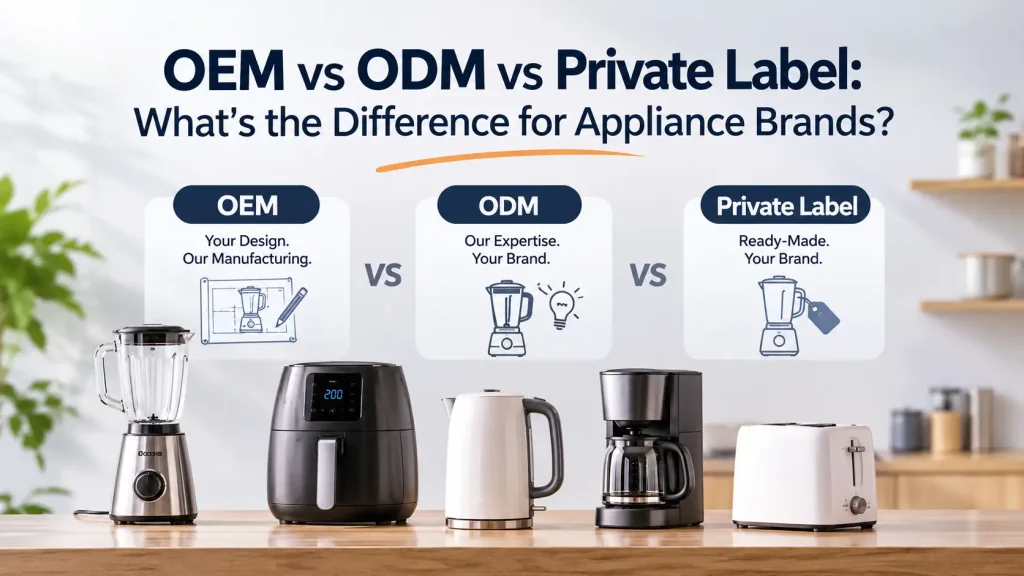
| Manufacturing Model | Typical Customization | Potential MOQ Considerations |
|---|---|---|
| Private Label | Logo, labels, packaging, and selected appearance options | Existing products and components may simplify production preparation |
| ODM | Modifications based on an existing product design or platform | Customized parts, functions, or materials may introduce additional purchasing requirements |
| OEM | Production based on buyer-defined designs and specifications | New tooling, custom components, engineering, and validation may affect the order quantity |
These are general distinctions, not fixed MOQ rules.
For example, a private-label electric kettle using an existing design and standard components may involve fewer customized production requirements than an OEM project requiring a new housing and control system.
However, an ODM project with extensive modifications can also involve substantial customization.
What buyers can do: Explain the intended customization level when requesting a quotation. Do not simply ask for the factory’s OEM MOQ. Ask for the minimum quantity under the exact configuration you plan to order.
Not sure which customization model best fits your business? Read our guide to OEM vs ODM vs private label manufacturing to understand the key differences and choose the right approach for your appliance project.
5. Tooling and Mold Investment
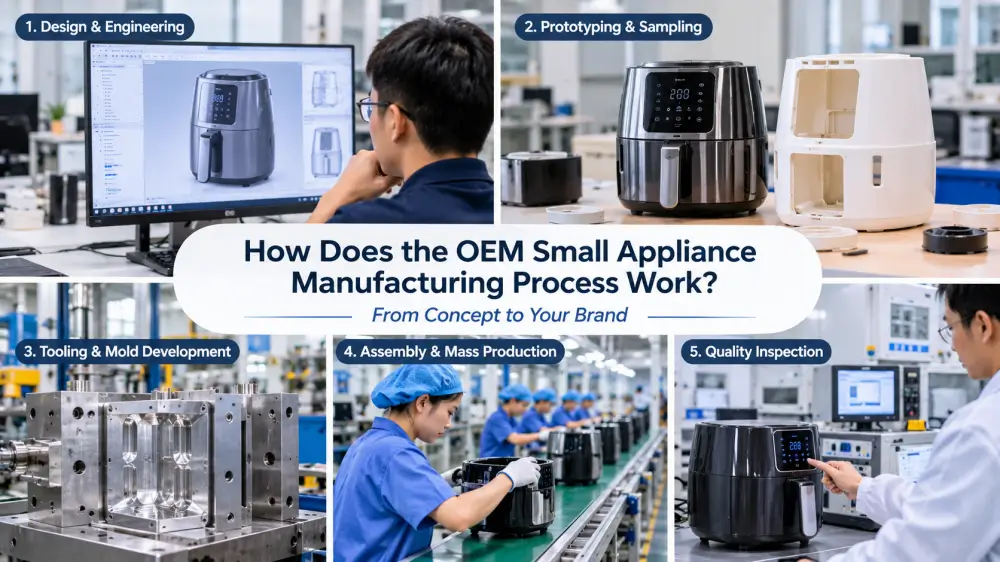
Custom plastic parts are common in small appliance manufacturing. When a project requires a new plastic housing or structural component, the manufacturer may need to develop new injection molds.
Tooling involves development and manufacturing costs before regular production can begin.
These costs are different from recurring production costs.
For example, a customized blender housing may require a new mold. The mold investment is a separate project cost, while the finished plastic parts still require raw materials, injection molding, inspection, and subsequent assembly.
Paying for the mold does not automatically eliminate production MOQ.
The manufacturer may still need to consider:
- Minimum raw material purchasing quantities.
- Injection molding machine setup and production efficiency.
- Component supplier minimums.
- Assembly line preparation.
- Inspection and packaging requirements.
What buyers can do:
Ask the supplier to separate tooling charges from recurring production costs. Also clarify who owns the mold, where it will be stored, how maintenance is handled, and whether future orders can use the same tooling.
If the first order is relatively small, discuss whether an existing mold or product platform can meet your requirements before investing in new tooling.
6. Packaging and Branding Requirements
Packaging is another factor that can increase the practical MOQ of a small appliance order.
A customized retail package may include:
- Printed color boxes.
- Product inserts and protective trays.
- User manuals.
- Warranty cards.
- Product labels and barcode labels.
- Accessory bags.
- Master cartons.
These materials may be supplied by different printing and packaging vendors. Each supplier can have its own production batch requirements.
For example, a manufacturer may be able to produce a smaller quantity of standard blenders, but the customized printed boxes may need to be ordered in a larger batch.
This can create a difference between the finished product quantity and the packaging purchase quantity.
What buyers can do:
Consider the following options:
- Use standard packaging for an initial market test.
- Customize the product logo while keeping the box design relatively simple.
- Use suitable standard cartons with approved labels or stickers.
- Ask whether packaging materials can be stored for future orders.
- Confirm the minimum quantity for each packaging item separately.
These options may help reduce initial packaging commitments, depending on supplier capabilities and the requirements of the target market.
7. Production Setup, Scheduling, and Order Configuration
Manufacturers need to prepare production equipment, materials, workers, inspection procedures, and assembly processes before starting an order.
These activities involve setup time and operational costs, even when the production quantity is relatively small.
For small appliance factories, production preparation may involve:
- Installing and adjusting molds.
- Preparing materials and components.
- Setting up assembly stations.
- Configuring production equipment.
- Arranging inspection and testing procedures.
- Preparing packaging and labeling operations.
When an order is divided into many small batches, models, or colors, production scheduling may become more complicated.
For example, an order of 2,000 appliances in one standard configuration is not necessarily equivalent to an order of 2,000 units divided among several models and multiple colors.
Each configuration may require different components, materials, production settings, or packaging.
What buyers can do: If your planned order includes several variations, ask whether the factory can consolidate production by sharing components, standardizing colors, or arranging production in batches.
The goal is to reduce unnecessary changeovers and purchasing complexity without compromising product requirements.
Why Can MOQ Differ Between Small Appliance Manufacturers?
Two factories may quote different MOQs for the same type of product. This does not necessarily mean one quotation is unreasonable.
The difference may come from their manufacturing arrangements.
| Factor | Why MOQ May Differ |
|---|---|
| Manufacturing capabilities | Some factories have more in-house processes, while others rely on external suppliers |
| Existing product platforms | A factory with a suitable existing design may need less customized sourcing |
| Supplier network | Different component and material suppliers have different purchasing requirements |
| Production planning | Factories may schedule orders and production batches differently |
| Customization scope | Some suppliers can support standard configurations more easily than highly customized products |
| Commercial policy | Factories may set different minimums based on their order management and business priorities |
For buyers, this means comparing MOQ alone is not enough.
A supplier offering a lower MOQ may have a higher unit price, fewer customization options, or different packaging requirements. Another supplier may request a larger order but offer more favorable production economics.
The quotations should be compared using the same product specifications and customization scope.
How Can Buyers Reduce MOQ for a Small Appliance Order?
If the manufacturer’s MOQ is higher than your initial purchasing plan, there are several practical ways to review the order.
1. Start With an Existing Product Platform
If you are launching a new product line, consider whether an existing product can meet your core functional requirements.
Using an established design may reduce the need for new molds, customized components, and additional engineering work.
You can still explore branding and selected appearance changes, depending on the manufacturer’s capabilities.
2. Reduce the Number of Colors
Multiple colors may require separate material preparation or production arrangements.
If you are testing a new market, starting with one standard color may simplify the first order.
Additional colors can be introduced after you have better information about customer demand.
3. Standardize Components Across Models
If you plan to purchase several related products, check whether they can share suitable components.
For example, some models may be able to use the same power cord, switch, packaging insert, or other standardized parts.
This depends on engineering compatibility and supplier requirements, but it can sometimes simplify procurement.
4. Simplify Customized Packaging
Custom packaging may have a separate purchasing minimum.
For an initial order, consider using standard cartons with suitable product labels or other approved branding elements.
You can evaluate fully customized retail packaging when the product’s sales volume becomes more predictable.
5. Discuss a Trial Order Separately
A small trial order may be useful for evaluating production quality, packaging, and market response.
However, a trial order is not automatically the same as the manufacturer’s regular mass-production MOQ.
The supplier may need to calculate a different unit price or setup charge for a smaller batch.
Ask for the commercial conditions of a trial run separately from the standard production quotation.
6. Provide a Realistic Follow-Up Forecast
If you expect to place repeat orders, share your estimated purchasing schedule with the manufacturer.
A forecast does not guarantee that the supplier will reduce the first-order MOQ, but it can help the manufacturer evaluate whether materials or components can be planned across multiple orders.
Be realistic about the forecast. Avoid promising future quantities that your business cannot reasonably support.
What Should Buyers Ask Before Confirming an MOQ?
Before placing an order, make sure the quotation explains the quantity requirements clearly.
The following questions can help avoid misunderstandings.
| Question | Why It Matters |
|---|---|
| Is the MOQ calculated per model or per total order? | Clarifies whether multiple models can be combined |
| Is the MOQ calculated per color? | Identifies separate color-related requirements |
| Does the MOQ include customized packaging? | Prevents confusion between product and packaging quantities |
| Are there separate component purchasing minimums? | Identifies supplier-side limitations |
| Are tooling and mold costs included in the quotation? | Separates one-time development costs from recurring production costs |
| Can a smaller trial order be arranged? | Helps evaluate options for a market test |
| What happens to unused packaging or materials? | Clarifies whether remaining materials can be used for future orders |
| Can the same components be used in repeat orders? | Helps plan procurement and future production |
A clear quotation should specify the product model, configuration, quantity, customization requirements, packaging details, tooling charges where applicable, and relevant commercial conditions.
This makes it easier to compare manufacturers and understand what you are actually paying for.
FAQ: MOQ in Small Appliance Manufacturing
Is MOQ the same for every small appliance product?
No. MOQ varies according to the product design, materials, components, customization, packaging, and manufacturing arrangements.
An electric kettle, blender, meat grinder, and air fryer may involve different components and production processes. Even two products in the same category can have different MOQ requirements if their specifications and customization levels differ.
Always request a product-specific quotation.
Can I combine different small appliance models to meet the MOQ?
Sometimes, but it depends on the factory’s production and purchasing arrangements.
If different models share components, materials, or packaging elements, the manufacturer may be able to consolidate some purchasing requirements.
However, the finished-product MOQ may still apply separately to each model. Ask the supplier which quantities can be combined and which must be calculated individually.
Does the MOQ include samples?
Usually, development samples and mass-production quantities are handled separately.
A sample may be produced for design review, functional testing, or approval before the production order is confirmed. Its price, production time, and quantity should be discussed separately.
Ask the manufacturer whether sample costs can be credited toward a future production order. This depends on the supplier’s commercial policy.
If I pay for a custom mold, can I order fewer products?
Not necessarily.
Paying for the mold may cover the one-time tooling investment, but it does not remove other production requirements.
The factory may still need to purchase materials, source components, prepare production equipment, and arrange assembly and inspection.
A custom mold and the MOQ for finished products should therefore be discussed as separate items.
Can I place one order now and receive the products in several shipments?
In some cases, yes, but this needs to be agreed with the manufacturer before production.
The factory may be able to produce the full quantity in one batch and arrange multiple shipments according to an agreed schedule.
However, the buyer may still need to pay for the full production quantity or meet the agreed payment terms. Storage, packaging protection, inventory management, and shipment costs also need to be considered.
This arrangement is different from producing several smaller orders over time.
Why is the unit price higher when I order below the standard MOQ?
A smaller order may require the same production preparation, material purchasing, or inspection work as a larger order.
When fixed setup costs are spread across fewer units, the cost per product can increase.
Some component suppliers may also offer less favorable pricing for smaller purchasing quantities.
Ask the manufacturer to explain whether the higher price comes from setup costs, component purchasing, material batches, or other factors.
Should a new brand always choose the lowest possible MOQ?
Not necessarily.
A lower MOQ can reduce the amount of inventory you need to purchase initially, but it may also increase unit cost or limit customization.
The right order quantity should balance expected sales, cash flow, landed cost, storage capacity, and the risk of unsold inventory.
A smaller first order is useful only when the overall commercial arrangement makes sense.
How can I tell whether an MOQ is negotiable?
Start by asking the manufacturer to explain what sets the minimum quantity.
If the limitation comes from a custom component, material batch, or packaging supplier, you may be able to discuss alternative specifications or purchasing arrangements.
If it comes from production setup or the factory’s commercial policy, the options may be different.
A useful discussion focuses on the actual constraint rather than simply asking the supplier to lower the number.
Conclusion
MOQ in small appliance manufacturing is influenced by several connected factors, including product complexity, raw materials, component suppliers, customization, tooling, packaging, and production setup.
For buyers, understanding these factors is more useful than comparing minimum quantities alone. A practical approach is to identify which part of the project determines the MOQ, simplify optional customization where possible, and compare quotations based on the same product configuration.
If you are planning a new small appliance order, discuss the product specifications, target quantity, customization scope, and packaging requirements with the manufacturer before confirming your purchasing plan.
Planning Your Next Small Appliance Project?
Kodio supports OEM and ODM projects across small kitchen appliances, home appliances, and personal care products. Share your product requirements and target order quantity with our team to discuss a suitable manufacturing approach.