Introduction: The True Cost of Non-Compliant Food Contact Materials
For importers of small electrical kitchen appliances, regulatory material compliance is no longer a peripheral checkbox left to factory discretion—it is an existential commercial factor. Customs enforcement across North America, the European Union, and Australasia has intensified dramatically. A container of air fryers or multi-cookers arriving at the Port of Rotterdam or Los Angeles with ambiguous material declarations risks immediate detention, mandatory re-export, or court-ordered destruction at the importer’s expense.
Beyond customs impoundment, public consumer alerts via the European Rapid Alert System for Food and Feed (RASFF) and the US Consumer Product Safety Commission (CPSC) trigger costly recalls and damage brand reputation.
Navigating the jurisdictional divide between the United States Food and Drug Administration (FDA) requirements, European Framework Regulation (EC) No 1935/2004, and Germany’s stringent LFGB (Lebensmittel-, Bedarfsgegenstände- und Futtermittelgesetzbuch) is critical for procurement executives. Understanding these regulatory boundaries allows brands to specify the right materials, avoid testing bottlenecks, and source compliant appliances with confidence.
+---------------------------------------------------------------------------------------------------+
|                         GLOBAL FOOD-CONTACT REGULATORY FRAMEWORK OVERVIEW                         |
+--------------------------+------------------------------------+-----------------------------------+
| Regulatory Standard      | US FDA (21 CFR Part 170-199)       | German LFGB (Bedarfsgegenstände)  |
+--------------------------+------------------------------------+-----------------------------------+
| Governing Jurisdiction   | United States of America           | Germany & EU Gold Standard        |
| Core Testing Focus       | Total Extraction Limits in Solvents| Overall & Specific Migration (SML)|
| Sensory Evaluation       | Not formally evaluated             | Mandatory (DIN 10955 Odor/Taste)  |
| Non-Stick Coatings       | Total extractable fluorides        | PFOA/PFOS/PFAS banned, SML heavy  |
| Silicone Compliance      | 21 CFR 177.2600 extraction test    | Volatile organic compounds < 0.5% |
| Plastics & Polymers      | Monomer extraction thresholds      | SML for Plasticizers & Primary AA |
| Heavy Metals Migration   | Standard release thresholds        | Stringent lead, cadmium, nickel   |
+--------------------------+------------------------------------+-----------------------------------+
Deconstructing the Standards: US FDA vs. European LFGB
While both systems aim to prevent harmful substances from leaching into food, their analytical methodologies and stringency diverge substantially.
The US Framework: FDA 21 CFR
In the United States, materials intended to contact food are regulated as “indirect food additives” under Title 21 of the Code of Federal Regulations (CFR), specifically Parts 175 through 178:
- Analytical Philosophy: FDA testing measures total extractive limits when materials are exposed to standardized food simulants (such as distilled water, 3% acetic acid, 8% or 50% ethanol, and n-heptane) across predetermined time-temperature matrices.
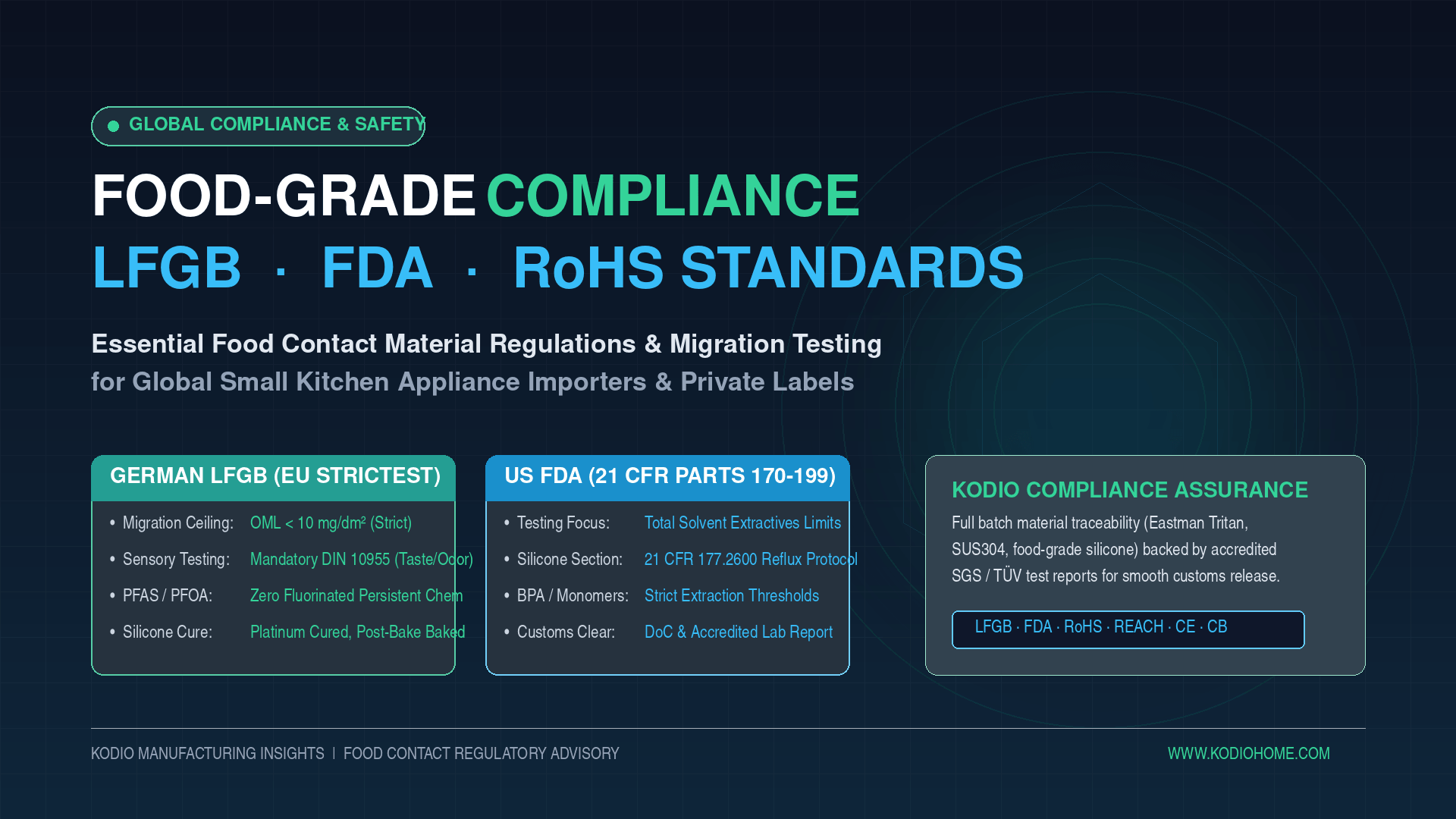
- Silicone & Elastomers: Tested under 21 CFR 177.2600 (rubber articles intended for repeated use), calculating total extractives in water at reflux for 7 hours, then 2 additional hours, ensuring extractives remain below 20 mg/in² and 1 mg/in² respectively.
- Scope: While rigorous regarding toxicological toxicity, standard FDA protocols omit sensory assessments of smell and taste alteration.
The European and German Framework: LFGB & Regulation (EC) 1935/2004
Under European Union Regulation (EC) No 1935/2004, materials must not transfer their constituents to food in quantities that could endanger human health, alter food composition unacceptably, or deteriorate sensory characteristics. Germany’s domestic implementation—LFGB Sections 30 & 31—represents the gold standard of European compliance. As highlighted in comprehensive compliance studies by testing authorities such as HQTS LFGB Testing Requirements, products meeting German LFGB standards easily satisfy compliance requirements across the rest of the European Union.
- Overall Migration Limit (OML): Enforces a strict ceiling of 10 mg/dm² (or 60 mg/kg of food simulant) for total non-volatile substances migrating into food.
- Specific Migration Limits (SML): Imposes precise parts-per-billion (ppb) ceilings on individual hazardous compounds, including Primary Aromatic Amines (PAAs), Bisphenol A (BPA), phthalates, and heavy metals (nickel, chromium, cobalt, arsenic, and lead).
- Mandatory Sensory Testing (DIN 10955): Samples are placed in contact with food stimulants under elevated temperature conditions. A certified sensory panel evaluates whether the material imparts any perceptible odor or flavor deviation. Any rating above a Grade 2.5 on a 0-to-4 intensity scale results in immediate compliance failure.
Component-by-Component Material Audits in Small Appliances
For an electric appliance, food safety compliance extends beyond the primary container—it encompasses every surface, seal, and internal air path that interacts directly or indirectly with food:
- Non-Stick Cooking Cavities (Air Fryers, Electric Ovens, Rice Cookers):
Standard non-stick fluoropolymer finishes (PTFE) face mounting regulatory pressure worldwide regarding persistent per- and polyfluoroalkyl substances (PFAS). Importers must verify that coatings are 100% PFOA-free, PFOS-free, and comply with EU Regulation (EU) 2019/1021 on Persistent Organic Pollutants (POPs). Premium appliance programs are rapidly migrating toward ceramic non-stick formulations (sol-gel silicon dioxide matrices) to achieve chemical inertness and higher scratch resistance.
- Transparent Blending & Processing Jars (Blenders, Food Choppers):
Standard polycarbonate (PC) plastics contain Bisphenol A and are broadly prohibited in contact with infant food or elevated temperatures across the EU and US. Premium manufacturers use Eastman Tritan™ copolyester or thermal-shock-resistant borosilicate glass. Sourcing documents must confirm that copolyesters pass Bisphenol analogues migration testing (BPA, BPS, BPF free).
- Stainless Steel Components (Stand Mixer Bowls, Chopper Blades, Electric Kettles):
Food-grade stainless steel must resist acidic and saline corrosion. High-quality bowls and internal kettle bodies must utilize certified SUS304 (18/8 austenitic stainless steel) or SUS316. Sub-tier factories attempting to cut costs often substitute low-nickel 201 or 430 grades, which leach manganese, chromium, and nickel during 3% acetic acid migration testing.
- Gaskets, Seals, and O-Rings (Juice Extractors, Blenders, Coffee Makers):
Flexible seals represent a frequent source of sensory failures. Low-cost peroxide-cured silicone releases residual volatile organic compounds (VOCs). Importers must mandate platinum-cured food-grade silicone, which undergoes secondary high-temperature post-curing baking cycles to strip all volatile oligomers, ensuring zero odor transfer.
The Overlap: How RoHS & REACH Intersect with Food Preparation Devices
While LFGB and FDA govern the direct food-contact zone, electrical small appliances must simultaneously meet comprehensive electronic safety and chemical directives:
- RoHS Directive (2011/65/EU and amendment 2015/863): Enforces maximum concentration values on 10 hazardous substances across all internal electronic components, PCBs, heating elements, wiring insulation, and power cords. It restricts Lead (<0.1%), Mercury (<0.1%), Cadmium (<0.1%), Hexavalent Chromium (<0.1%), and specific phthalate plasticizers (DEHP, BBP, DBP, DIBP <0.1%).
- EU REACH Regulation (EC No 1907/2006): Governs Substances of Very High Concern (SVHC). Importers must ensure that external plastic enclosures, silicone grips, and cosmetic finishes do not exceed the 0.1% w/w concentration threshold for candidate-list substances.
Kodio’s Regulatory Assurance and Factory Quality Framework
At Kodio, food safety engineering is integrated into the earliest stages of material selection and supply chain qualification:
- Certified Material Supply Chain Traceability: Kodio sources raw plastic resins (Tritan, food-grade PP, ABS), silicone compounds, and non-stick coatings strictly from tier-one certified material manufacturers (e.g., Eastman, DuPont, Whitford, or equivalent audited global chemical houses). Every incoming batch of raw pellets and metal sheets requires verifiable mill test certificates and original material safety data sheets (MSDS).
- Third-Party Laboratory Validation: Pre-production pilot units undergo rigorous third-party migration and toxicological testing through globally accredited test houses—including SGS, TÜV Rheinland, and Intertek. Kodio provides clients with complete test reports demonstrating full alignment with FDA 21 CFR, German LFGB, European CE, CB, and RoHS regulations.
- Secondary Curing and Production Deodorization Protocols: For products incorporating silicone gaskets or high-heat plastic components, Kodio implements specialized post-molding baking chambers that heat parts at 200℃ for over 4 hours, burning off trace volatile compounds to guarantee full compliance with DIN 10955 sensory testing before final packaging.
Procurement Takeaway: Food safety compliance cannot be retrofitted onto an assembled product. Importers must confirm that their manufacturing partners maintain raw material traceability, enforce strict incoming lot inspection, and furnish third-party accredited lab reports across all contact matrices prior to mass container dispatch.