The thousands of air fryer suppliers in China can be a minefield for global brand owners and importers to navigate. An air fryer is a high-wattage thermal appliance. If you deal with an unqualified supplier or a simple trading company pretending to be a source factory, the result can be catastrophic defect rates, recalls for safety reasons and serious brand erosion. To protect your supply chain and profit margins, you need to know how to separate real R&D-driven manufacturers from lower-tier workshops. Here are the 6 critical red flags to avoid when vetting air fryer manufacturers in China.
“Too Good to Be True” Pricing & Hidden Hardware Compromises
In international manufacturing, a particularly low FOB (Free on Board) price is seldom a miracle of efficiency. It is almost always a red flag of compromised hardware. A supplier quoting 20 to 30 % below the market average is obviously cutting invisible corners that will eventually kill the life of your product.
Unreliable factories will often substitute inferior alternatives for critical components to survive low-margin price wars:
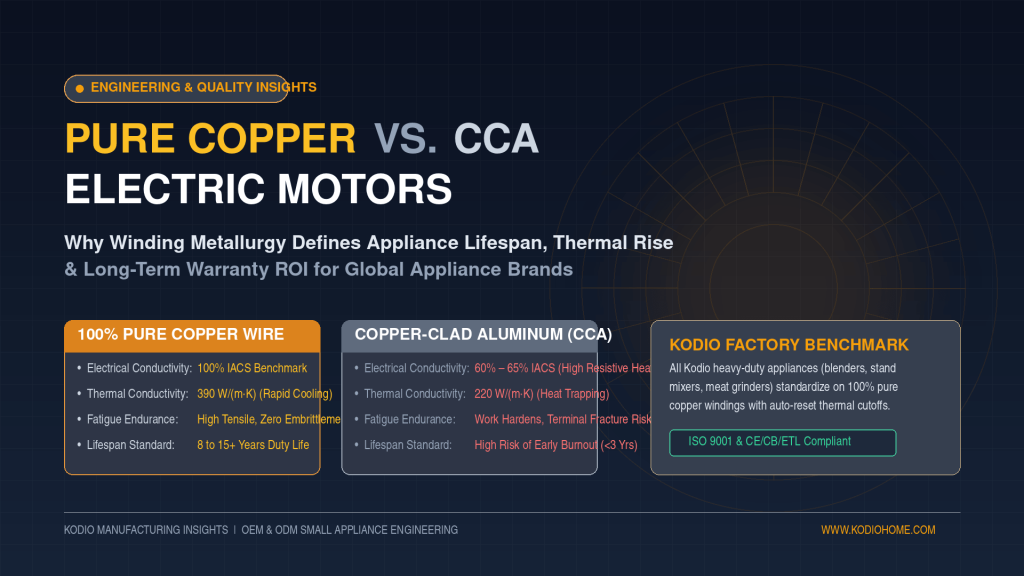
- Motor Downgrades: They replace high-torque, durable pure copper motors with cheap aluminum-wire motors. Aluminum motors degrade rapidly under continuous thermal stress, leading to fan failures and overheating within a few months of consumer use.
- Substandard Heating Elements: They utilize low-grade heating tubes that suffer from severe thermal drift, causing uneven cooking temperatures or premature burnout.
- Toxic Coatings: They apply non-certified, low-cost non-stick coatings to the frying baskets. Under high temperatures, these coatings can flake off or release toxic fumes, violating international food safety regulations.
The Solution: Never accept a quotation at face value. Always demand a detailed Bill of Materials (BOM) before signing a contract. A reliable manufacturing partner will transparently specify component brands, motor wire materials, and coating grades, ensuring your product is built for durability rather than just a cheap initial sale.
Vague Answers to Technical & Regional Grid Specs
An air fryer developed for the European market will not be a simple “plug and play” for North or South America. Electrical grids vary widely by region. The U.S. and parts of South America run on high current 110V–120V/60Hz grids, while Europe runs on 220V–240V/50Hz.
If you are asking a potential supplier about internal PCB (Printed Circuit Board) modifications, airflow thermal dissipation, or specific 110V current configurations, be sure to listen closely to their answer. If the sales guy says something along the lines of “Don’t worry, we can do any voltage with no problem”, and doesn’t even bother to consult with any engineering team or technical parameter sheets, you are probably dealing with a middleman or low-tier assembly workshop.
Converting a high-wattage heating appliance to a 110V/60Hz grid requires rigorous engineering adjustments to handle increased amperage safely without melting internal wiring or triggering thermal cut-offs. A seasoned, R&D-driven manufacturer will immediately provide comprehensive thermal rise test reports and explain the exact structural differences required for your target regional market.
Absence of In-Line Quality Control (IQC, IPQC, FQC) Workflows
Quality is not inspected into a product at the very end of the assembly line. It needs to be engineered and built into each stage of the manufacturing workflow. One of the biggest red flags when vetting factories is not providing documented, multi-stage quality control protocols.
If your supplier only provides a final packaging inspection checklist or relies only on assembly line workers to catch defects, your supply chain is at extreme risk. In professional appliance manufacturing, there are three quality defense walls you can’t compromise:
- IQC (Incoming Quality Control): Rigorous testing of raw materials before assembly begins. This includes verifying the purity of copper wiring, testing the flame-retardant grades of outer plastic casings, and auditing thermostat sensors from sub-suppliers.
- IPQC (In-Process Quality Control): Active monitoring along the assembly line, incorporating mandatory Hi-Pot (High Potential) electrical safety testing, grounding continuity checks, and real-time thermocouple calibration.
- FQC (Final Quality Control): Comprehensive fatigue running, aging tests, and drop-testing on finished batches before crating and shipping.
When evaluating a factory, always request historical QC logs and audit their testing lab equipment. Factories that invest in heavy diagnostic machinery are serious about brand protection.
Unverifiable Third-Party Compliance & Safety Certifications
In the realm of electric kitchen appliances, regional safety certifications are mandatory legal hurdles. Selling uncertified electrical goods can result in immediate customs seizures, mandatory platform takedowns (such as on Amazon), and crushing liability lawsuits.
Be on high alert if a supplier exhibits any of the following behaviors regarding compliance:
- Claiming a certification is “currently in process” to secure your deposit.
- Providing a certificate where the manufacturer’s name does not match the factory you are dealing with (a common tactic among trading companies borrowing a partner factory’s credentials).
- Offering outdated or incomplete test reports that do not cover the specific model number you are purchasing.
Depending on your distribution footprint, your supplier must be able to provide authentic, verifiable third-party test reports from recognized bodies such as UL Solutions or Intertek (ETL) for North America, and CE, GS, RoHS, and REACH documentation for Europe. Always have your compliance team cross-reference certificate numbers directly on the issuing agency’s public database.
Lack of In-House Tooling & Narrow “Single-Product” Focus
Many importers fall into the trap of partnering with rigid “single-product” assembly plants. These factories rely entirely on a limited set of open-market molds. If you ask them to modify the external industrial design, adjust the internal basket capacity, or develop a proprietary user interface, they will either refuse or quote exorbitant tooling fees with six-month lead times.
More importantly, a factory that only knows how to build simple air fryers is not confident in structural engineering. This becomes a huge limitation to your brand growth when you want to expand your catalog to other profitable product categories.
Elite OEM/ODM manufacturers are characterized by strong in-house tooling workshops and cross-category R&D capabilities. If a factory has deep engineering roots in motor durability, fluid dynamics and precision temperature control, those core competencies naturally transfer across product lines. A truly flexible manufacturing partner can capitalize on the advanced thermal and motor technologies honed in kitchen appliances to create high-performance home electronics and personal care devices, serving as an end-to-end incubator for your brand’s entire product ecosystem.
Reluctance to Provide Real Samples or Allow Factory Audits
The willingness of a supplier to be scrutinized is the ultimate test of their authenticity. Step away right away if a manufacturer refuses to send customized engineering prototypes, consistently postpones sample delivery, or resists on-site factory audits by third-party inspection companies (such SGS, BV, or BSCI).
Unacceptable manufacturing realities, such as dangerous workshop conditions, ghost production lines, or the unapproved subcontracting of your order to subpar, unmonitored back-alley workshops, are typically hidden by a refusal to allow physical audits. Transparency is welcomed in a self-assured, professional factory. They will gladly host a video tour for your team, provide independent social and quality audits, and collaborate with you through several iterations of prototyping until the physical sample functions flawlessly under intense stress testing.
Conclusion
When sourcing air fryers from China, it’s important to look past cheap FOB pricing to ensure genuine regional conformity, rigorous in-line quality control, and actual engineering depth. You can protect your company from expensive supply chain catastrophes and develop a product line that customers trust by actively looking for these six warning signs.
Founded in 2009, Kodio is a reputable international OEM and ODM manufacturer that assists companies in Europe, the Americas, and Asia-Pacific in creating dependable home, kitchen, and personal care appliances. We offer adaptable, comprehensive production solutions supported by strict quality assurance and cross-category research and development.
Are you prepared to modernize your supply chain for appliances? To obtain our most recent technical parameter sheets, examine our compliance portfolios, or talk about developing a custom product for your target market, get in touch with Kodio’s engineering team right now.
Partnering with a factory that passes these rigorous quality checks allows for highly flexible and successful product launches. See this in action in our recent [Case Study: Helping a Customer Launch Two Blender Models with Flexible MOQ].