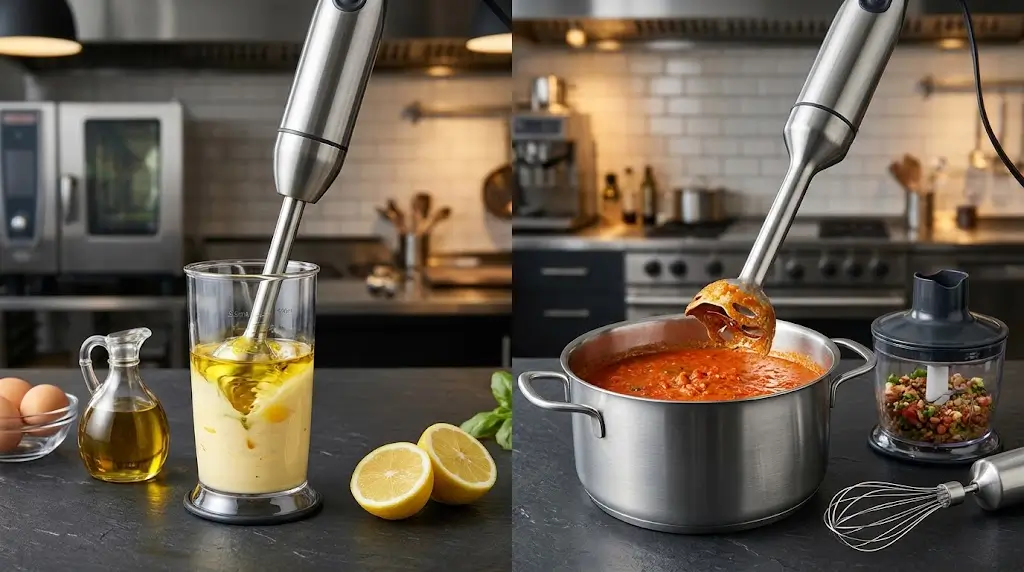
Choosing between an emulsion blender and an immersion blender can be confusing, especially when product descriptions use these terms interchangeably. Both types of equipment can help combine ingredients, create smooth textures, and prepare sauces, but their capabilities depend on their design, blade configuration, motor performance, and intended application.
For home cooks, the main question is whether a standard immersion blender can handle recipes such as mayonnaise, salad dressings, and creamy soups. For appliance brands, importers, and distributors, the decision also involves product positioning, target customers, functional requirements, and manufacturing specifications.
The key point is that an emulsion blender and an immersion blender are not always two separate appliance categories. An immersion blender can emulsify ingredients, while an emulsion blender may refer to a handheld immersion blender designed for emulsifying or to specialized equipment developed for more demanding mixing applications. Understanding the product’s actual design and intended use is more useful than relying on its name alone.
1. What Is an Emulsion Blender?
An emulsion blender is a term used for equipment designed to help combine ingredients that do not naturally mix well, such as oil and water. Depending on the manufacturer and industry, the term may describe a handheld blender with effective emulsifying capabilities or a specialized machine used for more controlled mixing.
To understand its function, it helps to know what an emulsion is.
An emulsion forms when droplets of one liquid are dispersed throughout another liquid that would not normally mix with it. Mayonnaise is a familiar example: oil is dispersed throughout a water-based mixture containing ingredients such as egg yolk and lemon juice.
Emulsifying equipment helps break one liquid into smaller droplets and distribute them throughout the mixture. The stability of the final product also depends on the formulation, emulsifying ingredients, processing conditions, and mixing method.
Common applications of emulsion blenders
Depending on the equipment’s design and capacity, applications may include:
- Mayonnaise and aioli: Combining oil with an aqueous ingredient mixture to create a thick, creamy condiment.
- Salad dressings and vinaigrettes: Distributing oil throughout vinegar, citrus juice, or other liquid ingredients.
- Sauces and condiments: Producing a more uniform texture in suitable recipes.
- Creamy mixtures: Combining ingredients that require consistent mixing and a smooth finish.
- Food production: Processing emulsions in commercial or industrial settings when the machine is specifically designed for the required batch size and workload.
Not every device marketed as an emulsion blender is suitable for every application. A compact handheld model intended for occasional kitchen use should not automatically be treated as industrial emulsification equipment.
2. What Is an Immersion Blender?
An immersion blender, also known as a hand blender or stick blender, is a handheld electric appliance with a motorized handle, a long blending shaft, and rotating blades protected by a guard.
Unlike a countertop blender, it is inserted directly into a pot, bowl, or suitable container. This allows users to blend ingredients without transferring them to a separate blending jar.
Immersion blenders are commonly used in home kitchens because they are compact, convenient, and versatile.
Common applications of immersion blenders
A suitable immersion blender can handle a variety of everyday food preparation tasks:
- Soups and purees: Blending cooked vegetables directly in a cooking pot.
- Smoothies: Mixing soft fruit and liquid ingredients in a suitable container.
- Mayonnaise and salad dressings: Emulsifying ingredients when the blade design, container, and recipe are appropriate.
- Sauces and dips: Combining ingredients to achieve a more uniform consistency.
- Baby food: Pureeing cooked ingredients into a smooth texture.
- Whipped mixtures: Working with selected ingredients when a compatible whisk attachment is available.
The main advantage is convenience. Users can blend directly in the container where ingredients are prepared, reducing the need for extra equipment and cleanup.
However, immersion blenders vary considerably. Motor performance, blade geometry, shaft length, speed control, and accessories all influence what a particular model can do.
3. Emulsion Blender vs Immersion Blender: Key Differences
Before comparing the two, remember that the terms may overlap. The following table compares a general-purpose immersion blender with an emulsion-focused blender or specialized emulsifying machine.
| Comparison Factor | General-Purpose Immersion Blender | Emulsion-Focused Blender or Specialized Equipment |
|---|---|---|
| Primary purpose | Blending, pureeing, and mixing a range of ingredients | Emulsifying ingredients or processing specific mixtures |
| Typical design | Handheld motor, shaft, and guarded blade | May be handheld or designed for a dedicated processing setup |
| Mayonnaise and dressings | Suitable for many recipes with the right technique | Suitable when the design and operating parameters meet the recipe’s requirements |
| Soups and purees | A common application | Depends on the equipment’s design and intended use |
| Batch size | Depends on the operator, container, motor, and model limitations | Depends on the machine’s rated processing capacity |
| Mixing control | Varies by speed settings, blade design, and operator technique | May offer specialized mixing or process controls, depending on the equipment |
| Commercial production | Some models suit light-duty foodservice tasks | Specialized models may be designed for repetitive or larger-scale production |
| Cleaning | Often involves rinsing or washing the blending shaft and accessories | Depends on whether the equipment is handheld, detachable, or part of a fixed processing system |
The practical difference is not simply that one blender emulsifies while the other does not. Many immersion blenders can emulsify effectively. The important question is whether a specific model can deliver the required texture, batch size, consistency, and operating performance.
Difference 1: Primary function
A general-purpose immersion blender is designed to perform several kitchen tasks. Emulsification is one of its possible functions, alongside pureeing soups, blending sauces, and mixing soft ingredients.
An emulsion-focused model prioritizes the requirements of a particular mixing process. In more specialized equipment, this may involve a different blade assembly, mixing head, speed range, or processing configuration.
However, the product label alone does not prove that one machine produces a more stable emulsion than another. Performance should be evaluated using the actual recipe and operating conditions.
Difference 2: Blade design and mixing action
Blade geometry influences how ingredients move through the blending head and how effectively liquids are dispersed.
A conventional immersion blender typically uses rotating blades within a protective guard. The blade assembly creates circulation and shearing action that breaks down ingredients and helps mix them together.
Specialized emulsifying equipment may use a mixing head or rotor-stator configuration designed to generate more controlled shear. Such systems can be useful for specific formulations, but they are not standard features of every product sold as an emulsion blender.
When comparing products, examine the blade or mixing-head design rather than assuming that a particular name guarantees a particular result.
Difference 3: Batch size and operating requirements
For occasional cooking, a handheld immersion blender may be sufficient for a small bowl of mayonnaise, a portion of sauce, or a pot of vegetable soup.
Commercial applications may require more careful consideration. A restaurant preparing sauces repeatedly, for example, needs equipment suited to the volume processed, expected operating frequency, ingredient thickness, and cleaning routine.
For larger production batches, a specialized emulsifying machine may be more appropriate than a consumer hand blender. Always check the manufacturer’s rated capacity and operating limitations.
Difference 4: Versatility
A general-purpose immersion blender is often the more flexible choice for everyday cooking. Depending on the model and attachments, it may blend soups, puree vegetables, prepare dressings, and whip selected ingredients.
Specialized emulsifying equipment may be more appropriate when a particular formulation or production process requires a dedicated mixing method.
The right choice depends on whether versatility or process-specific performance is the main priority.
4. Can an Immersion Blender Make an Emulsion?
Yes. A suitable immersion blender can emulsify ingredients and is commonly used to prepare mayonnaise, aioli, vinaigrettes, and other sauces.
For many home cooks, purchasing a separate appliance solely for emulsification is unnecessary. The more important factors are the blender’s design, the recipe, the mixing container, and the technique used.
How to make a more stable emulsion
Follow these practical steps when making mayonnaise or a similar oil-based sauce.
Step 1: Choose a suitable container.
A tall, narrow container can help keep the ingredients close to the blending head and reduce splashing. Make sure the blade guard can fit inside comfortably.
Step 2: Add the ingredients according to the recipe.
For mayonnaise, this may include egg yolk or whole egg, lemon juice or vinegar, and oil. Follow a tested recipe and its recommended ingredient proportions.
Step 3: Position the blending head correctly.
Keep the blade fully submerged before switching on the appliance. This helps reduce splashing and allows the ingredients to circulate around the blades.
Step 4: Begin blending and incorporate the oil gradually when required.
Some immersion-blender mayonnaise methods allow the ingredients to be added together before blending. Other recipes call for adding the oil slowly. Follow the method appropriate to your recipe and blender.
Step 5: Adjust the texture carefully.
Once the mixture begins to thicken, continue blending only as needed to achieve a uniform consistency. Excessive processing may warm the mixture or produce an undesirable texture.
What if the emulsion separates?
A broken emulsion may result from the ingredient proportions, mixing technique, temperature, or the condition of the emulsifying ingredients.
To troubleshoot the problem:
- Check that the recipe uses the correct proportions of oil and liquid ingredients.
- Use an appropriate container that allows the blade to contact the mixture effectively.
- Avoid lifting the blender out of the mixture too early when the recipe requires the ingredients to emulsify at the bottom first.
- If the mixture has separated, try starting with a fresh emulsifying base and gradually blending the broken mixture into it, following a reliable recipe’s recovery method.
A higher motor rating alone will not guarantee a stable emulsion. Recipe formulation and technique remain important.
5. Which Blender Should You Choose for Different Applications?
The most effective way to choose between an immersion blender and an emulsion-focused appliance is to start with the intended task.
| Application | Recommended Starting Point | What to Check |
|---|---|---|
| Homemade mayonnaise | Immersion blender with suitable blade design | Container fit, blending technique, and control |
| Salad dressing and vinaigrette | General-purpose immersion blender | Small-batch performance and ease of cleaning |
| Creamy vegetable soup | Immersion blender | Shaft length, blade guard, and hot-food instructions |
| Fruit smoothies | Immersion blender for suitable soft ingredients and small portions | Ingredient limitations and required smoothness |
| Thick sauces and purees | Suitable immersion blender or specialized equipment | Mixture thickness, liquid content, and motor limitations |
| Repeated commercial sauce preparation | Commercial immersion blender or specialized mixer | Rated capacity, duty cycle, cleaning, and consistency |
| Large-scale emulsion production | Equipment designed for the specific process | Batch volume, shear requirements, process control, and sanitation |
For home users
If you mainly prepare soups, sauces, mayonnaise, and small batches of dressings, a well-designed immersion blender is often a practical starting point.
Look for a comfortable grip, accessible speed controls, a suitable blending shaft, and components that are easy to clean. Attachments such as a whisk or blending beaker may expand its usefulness.
If you frequently prepare large quantities or require a tightly controlled emulsification process, evaluate specialized equipment instead.
For restaurants and foodservice businesses
Restaurants should consider the volume and frequency of preparation, not just the number of functions listed on the product packaging.
A handheld commercial immersion blender may be appropriate for preparing soups and sauces in large cooking vessels, provided its specifications support the task. A specialized emulsifying machine may be more suitable when the recipe requires a particular mixing action or repeatable processing conditions.
Before selecting a machine, test it with the actual ingredients and batch size whenever possible.
For brands, importers, and distributors
Product selection also involves understanding the needs of the intended market.
A compact immersion blender aimed at household consumers may need straightforward controls, convenient storage, practical accessories, and simple cleaning. A product intended for frequent food preparation may require different considerations for construction, ergonomics, and operating limits.
Buyers evaluating OEM or ODM opportunities should define the target application before discussing technical specifications. This helps ensure that the product design, features, and positioning align with the intended customers.
6. What Should You Look for When Choosing an Immersion Blender?
If a general-purpose immersion blender meets your needs, several design factors deserve attention.
Motor performance and speed control
Consider the ingredients you plan to process and how frequently the blender will be used. Different models have different motor capabilities and operating limits.
Variable speed control can help users adjust blending intensity for different recipes. However, wattage alone is not a reliable measure of overall blending quality.
Blade design and blending shaft
The blade assembly affects ingredient circulation, blending efficiency, and the resulting texture.
Shaft length is also important. The blending head should reach the ingredients while allowing the motor handle to remain clear of the food and liquid.
For hot preparations, follow the manufacturer’s instructions regarding maximum temperature, suitable containers, and safe operation.
Ergonomics and ease of use
A comfortable handle, accessible controls, manageable weight, and secure attachment mechanism can make a difference during repeated use.
For retail products, these details also influence the overall user experience and the product’s suitability for the target market.
Cleaning and maintenance
Food can collect around the blade guard and shaft after use. Detachable blending shafts may simplify cleaning, but users should check which components can be immersed or washed separately.
Never submerge the motor housing unless the manufacturer explicitly permits it. Unplug the appliance before cleaning and follow the product’s care instructions.
Accessories and versatility
Depending on the product design, a blending beaker, whisk, or chopper attachment may extend the appliance’s functions.
For buyers comparing models, consider whether the accessories solve real customer needs rather than simply increasing the number of items in the package.
7. OEM and ODM Considerations for Blender Brands
For appliance brands and importers, the distinction between an emulsion blender and an immersion blender can also affect product development and market positioning.
Before sourcing a product, clarify what customers expect the appliance to do. A product marketed for everyday blending and a product intended for specialized emulsification may require different designs, specifications, and supporting documentation.
Important questions include:
- Target application: Is the product intended for soups and purees, sauces and dressings, or a more specialized mixing process?
- Performance requirements: What ingredients, batch sizes, textures, and operating frequencies must the product support?
- Product design: Which shaft length, blade configuration, speed controls, and accessories are appropriate?
- User experience: How important are ergonomics, cleaning, storage, and ease of operation?
- Market requirements: Which applicable safety, electrical, labeling, and regulatory requirements must be addressed in the intended sales markets?
- Brand positioning: Should the product be positioned as an everyday kitchen appliance, a versatile hand blender, or a solution for a defined food-preparation task?
These questions provide a more useful starting point than selecting a product based on its name alone.
As a global OEM and ODM small appliance manufacturer established in 2009, Kodio works with brands, distributors, retailers, and importers on customized consumer appliance development and manufacturing. Its end-to-end approach covers product concept, industrial design, engineering, production, quality control, and logistics.
For businesses developing a hand blender or related small kitchen appliance, aligning the intended application with the product’s design and target market is an important step toward a suitable product offering.
Learn more about Kodio at https://kodiohome.com/ or contact the team to discuss your product development requirements.
Frequently Asked Questions
Is an emulsion blender the same as an immersion blender?
Not always, but the terms can overlap. An immersion blender is a handheld appliance designed to blend ingredients directly in a container. The term emulsion blender may describe an immersion blender used for emulsification or specialized equipment designed for a particular mixing process. Check the actual product design and specifications.
Can an immersion blender make mayonnaise?
Yes. A suitable immersion blender can combine oil with the other ingredients to make mayonnaise. Use an appropriate container and follow a reliable recipe, since ingredient proportions and technique affect the final consistency.
Is an emulsion blender better for sauces?
It depends on the sauce and the equipment. Many immersion blenders work well for everyday sauces, dressings, and mayonnaise. Specialized emulsifying equipment may be more appropriate for particular formulations or production requirements.
Can an immersion blender replace a countertop blender?
It can replace a countertop blender for some tasks, including many soups, sauces, purees, and small batches of soft ingredients. However, it is generally less suitable for crushing ice, processing large quantities of frozen ingredients, or handling tasks that require a powerful countertop blender.
What is the difference between an immersion blender and a commercial emulsifier?
An immersion blender is a handheld appliance used for general blending and pureeing. A commercial emulsifier may refer to equipment designed for more specific mixing requirements, potentially including specialized mixing heads, higher processing capacities, or more controlled operating conditions. The actual differences depend on the machines being compared.
What should importers consider when sourcing an immersion blender?
Importers should evaluate intended applications, product specifications, ease of cleaning, user ergonomics, accessories, quality control, applicable market requirements, and supplier customization capabilities. The final selection should reflect the needs of the target market rather than relying on a single specification such as wattage.