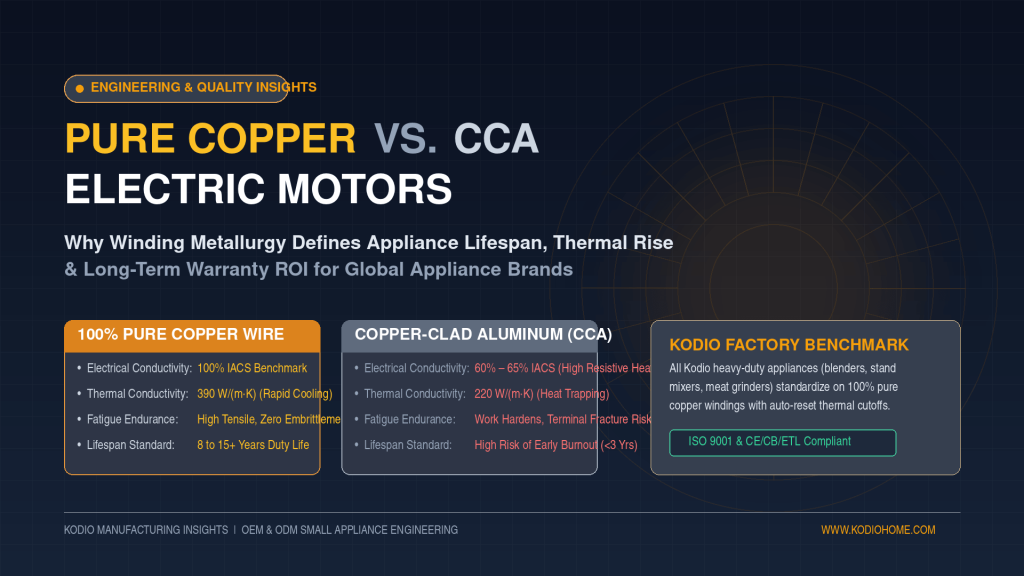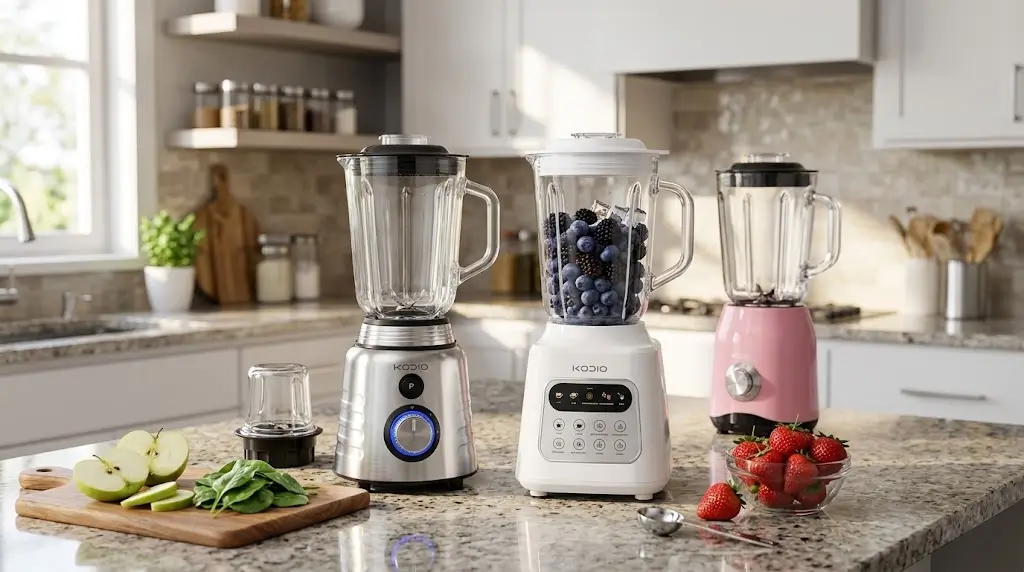
On average, a standard household blender lasts 3 to 5 years, while compact personal blenders typically last 2 to 4 years. In contrast, heavy-duty and commercial-grade blenders engineered with high-torque, pure copper motors can easily last 8 to 15+ years under regular use.
Lifespan is primarily governed by motor winding quality, drive coupler design, usage frequency, and workload intensity (e.g., crushing dense ice vs. blending soft fruits).
Average Blender Lifespan: Quick Comparison by Blender Type
Not all blenders are engineered for the same duty cycle. A single-serve bullet blender running daily on frozen fruit operates under far more thermal stress than an occasional-use countertop model.
| Blender Type | Average Lifespan | Typical Motor Wattage | Rated Duty Cycle / Life | Primary Use Case |
| Personal / Single-Serve Blenders | 2 – 4 Years | 250W – 900W | 500 – 1,000 Cycles | Daily single-portion smoothies, protein shakes |
| Entry-to-Mid Countertop Blenders | 3 – 6 Years | 500W – 1,000W | 1,000 – 2,000 Cycles | Family smoothies, purees, salsas, light crushing |
| Immersion / Hand Blenders | 4 – 7 Years | 300W – 800W | 800 – 1,500 Cycles | Soups, sauces, emulsifications directly in pots |
| High-Performance / Prosumer Blenders | 7 – 12 Years | 1,200W – 1,800W | 3,000 – 5,000 Cycles | Nut butters, hot soups, daily heavy-duty crushing |
| Commercial / Bar Blenders | 10 – 15+ Years | 1,500W – 2,200W+ | 5,000 – 10,000+ Cycles | Continuous commercial foodservice operation |
4 Engineering Factors That Determine How Long a Blender Lasts
From a product engineering and manufacturing standpoint, a blender’s lifespan is not decided by exterior aesthetics—it is determined by internal component architecture and thermal management.
       [ Power & Drive Train Durability ]
 Motor Core (Pure Copper) ──► Drive Coupler (Metal/Hybrid) ──► Blade Assembly (SUS420)
            │                            │                            │
   Thermal Protection            Sacrificial Clutch             Dual Ball Bearings
1. Motor Construction: Pure Copper vs. Aluminum Windings
The motor is the heart of the appliance. Lower-tier blenders often utilize copper-clad aluminum (CCA) windings to reduce unit manufacturing costs. CCA motors run hotter, exhibit higher electrical resistance, and degrade faster under sustained loads.
High-durability blenders utilize 100% pure copper wire windings paired with integrated Auto-Reset Thermal Overload Protectors (TCO). Copper windings resist electrical heat buildup, while thermal protectors temporarily cut power before operating temperatures can melt motor insulation or short the armature.
2. Drive Coupler & Bearing Architecture
The drive coupler (or drive socket) transfers rotational kinetic energy from the motor shaft to the blade assembly at speeds exceeding 18,000 to 24,000 RPM.
- Plastic/Rubber Couplers: Act as sacrificial fail-safes to protect the motor from seizing if blades jam. However, low-grade rubber teeth strip quickly under heavy frozen loads.
- All-Metal / Zinc-Alloy Couplings: Offer superior torque transfer and long-term wear resistance.
- Bearing Design: Standard blenders utilize porous bronze sleeve bushings that dry out over time. Premium models use sealed dual stainless steel ball bearings and food-grade fluorosilicone seals to prevent moisture ingress into the motor housing.
3. Blade Metallurgy & Edge Geometry
Blender longevity depends on structural blade toughness rather than razor sharpness:
- SUS301 / SUS304 Stainless Steel: Common in entry-level units; adequate for soft blending but prone to bending, dulling, or pitting when exposed to continuous ice crushing.
- Hardened SUS420 / 440C Stainless Steel: Heat-treated to a Rockwell hardness of HRC 54–58. These blades pulverize ingredients by high-speed kinetic impact rather than slicing, maintaining structural integrity over thousands of operational cycles without chipping.
4. Pitcher Material & Thermal Shock Resistance
- Standard AS / SAN Plastic: Inexpensive and lightweight, but susceptible to micro-cracking, crazing, and clouding from acidic foods, dishwasher heat cycles, or accidental drops.
- Eastman Tritan™ Copolyester (TX2001/TX1001): BPA-free, shatterproof, and highly resistant to chemical and thermal fatigue (-40°C to 100°C).
- Tempered Borosilicate Glass: Impervious to scratching and odors, but vulnerable to mechanical shock and thermal shock if boiling liquid is poured directly into cold glass.
6 Clear Signs It Is Time to Replace Your Blender
When a blender begins to degrade, it exhibits clear mechanical, electrical, and thermal warning signals:
                  ┌─── Burnt plastic/ozone smell during blending
                  ├─── Liquid leaking from jar bottom into motor base
 BLENDER FAILURE  ├─── High-pitched grinding or screaming sounds (Bearing wear)
     SIGNALS      ├─── Drive coupler stripping / Motor spins but blade stalls
                  ├─── Jar hairline cracks or crazing near the blade base
                  └─── Inconsistent, chunky blending textures on standard recipes
- Persistent Burning Odor (Ozone / Burnt Plastic): A light odor on a brand-new blender can be factory protective coatings evaporating. However, a persistent acrid smell in an older unit indicates armature brush degradation or overheating stator coil insulation.
- Liquid Leaking From the Pitcher Base: Leaks around the blade housing indicate that the rubber gasket or silicone mechanical shaft seal has failed. If liquid enters the top bearing, it washes away lubricant and drips into the motor, creating a severe short-circuit hazard.
- Screeching or Metallic Grinding Noises: A sharp, grinding acoustic signature indicates worn-out motor bearings or loose blade shaft assemblies.
- Motor Runs, but Blades Slip or Stall Under Load: If the motor whirs loudly at full speed while the blade hesitates in thick mixtures, the drive coupler teeth have stripped or the drive clutch is slipping.
- Structural Cracks or Clouding in the Pitcher: Deep fissures near the bottom blade mount compromise structural integrity and can shatter under high hydrostatic blending pressure.
- Blunt Blades and Inconsistent Pureeing: When a recipe that previously took 30 seconds now takes 2 minutes and leaves fibrous chunks, the blade impact edges or motor RPM output have deteriorated beyond their useful threshold.
Repair vs. Replace: How to Make the Smart Decision
Before disposing of your appliance, evaluate whether a targeted component replacement can restore functionality cost-effectively.
                                  [ Is the Motor Base Working? ]
                                                │
                       ┌────────────────────────┴────────────────────────┐
                      YES                                                NO
                       │                                                 │
            [ Component Failure? ]                              [ Check Appliance Age ]
            ┌──────────┴──────────┐                                      │
       Gasket/Blade/Jar      Internal Motor/PCB                 Under 3 Yrs     Over 5 Yrs
            │                     │                                  │               │
      ► REPLACE PART        ► REPLACE UNIT                    ► WARRANTY/FIX   ► REPLACE UNIT
Replace the Part When:
- The issue is a worn sealing gasket or chipped blade assembly: Most major brands and OEM platforms offer drop-in blade and gasket kits for $10–$25.
- The pitcher is cracked, but the motor base is sound: Sourcing a replacement Tritan or glass jar is significantly cheaper than purchasing an entirely new system.
- The sacrificial drive socket is stripped: Drive couplers can often be replaced with a simple wrench in under 10 minutes.
Replace the Whole Blender When:
- The motor itself has seized or burnt out: Motor assembly replacement costs (parts plus labor) typically exceed 60–70% of a new machine’s retail price.
- The electronics or control PCB failed: Models with capacitive touch controls or smart sensors are rarely economical to repair once out of warranty.
- The blender is an entry-level unit (<$40 retail): Replacement components and shipping often match or exceed the original retail value.
5 Pro Maintenance Rules to Extend Your Blender’s Lifespan
Proper operating habits significantly reduce mechanical strain on the motor and drive components:
- Layer Ingredients Correctly: Always add liquids and soft ingredients first, followed by dense produce, leafy greens, and finally ice or frozen items on top. This creates a fluid vortex immediately, preventing air pockets and motor cavitation.
- Never Run the Blender Empty: Operating without load causes over-revving and excessive friction between dry mechanical seals and bearings.
- Respect Duty Cycles: For standard domestic blenders, avoid continuous blending for more than 60–90 seconds at a stretch. Use the Pulse function to break up hard items, and allow 30–60 seconds of cooling time between heavy batches.
- Clean Immediately via Self-Clean Cycle: Fill the jar halfway with warm water and one drop of dish soap, then run on high for 30 seconds. Avoid soaking the blade base in soapy water, as detergent breaks down the internal bearing grease.
- Keep Motor Base Vents Clear: Ensure the ventilation intakes on the bottom of the blender base remain free of dust, paper towels, and countertop spills to maintain proper convection cooling.
Sourcing Durable Blenders: The OEM/ODM Perspective
For small appliance brands, importers, and private label distributors, blender longevity is directly linked to product review ratings, brand equity, and warranty return costs. Achieving an extended product lifespan requires rigorous engineering standards at the factory level.
At Kodio, small appliance engineering focuses on longevity-first principles:
- Validated Lifecycle Testing: Comprehensive life testing exceeding 2,000–3,000 continuous blending cycles under full load specifications.
- Optimized Thermal Architecture: Custom airflow motor housings paired with pure copper windings and high-tolerance thermal protection.
- Premium Materials Compliance: High-grade SUS420 stainless steel blades, food-grade silicone seals, and certified BPA-free Eastman Tritan™ pitchers meeting international safety standards (CE, CB, GS, RoHS, FDA, LFGB, ETL).
Whether you are looking to develop custom high-performance blenders or optimize existing product lines for reduced defect rates, partnering with an experienced OEM/ODM manufacturer ensures lasting market success.
5. Frequently Asked Questions (FAQ)
How many years should an average kitchen blender last?
An average kitchen countertop blender lasts 3 to 5 years with regular domestic use (3–5 times per week). High-performance prosumer models with heavy-duty copper motors typically last 7 to 10+ years, while budget personal blenders last around 2 to 3 years.
Can you sharpen blender blades, or should you replace them?
Blender blades should generally be replaced rather than sharpened. Modern high-speed blenders pulverize food via blunt impact speed (over 20,000 RPM) and blade geometry rather than razor sharpness. Attempting to sharpen them with files or eggshells can unbalance the blade assembly, causing shaft wobble and bearing failure.
Why did my blender suddenly stop working while blending?
If your blender shuts off mid-cycle during a thick blend, the thermal overload protector has likely tripped to prevent motor burnout. Unplug the blender, remove the jar, and let the base cool down for 15 to 30 minutes. Also check if the blades are mechanically jammed by oversized ingredients.
Does blending ice ruin blender blades?
Blending large ice cubes can dull or nick lower-grade stainless steel blades (such as standard SUS301) and stress low-wattage motors (<500W). Blenders with hardened SUS420 stainless steel blades and high-torque motors (800W+) are specifically engineered to crush ice without structural damage, especially when combined with liquid.
How do I know if my blender drive coupler is broken?
If the motor base turns smoothly and makes normal operational noise, but the blades inside the pitcher spin sluggishly or stop completely when ingredients are added, the rubber or metal teeth on the drive coupler have stripped.