Introduction: The Hidden BOM Trap in Appliance Sourcing
In countertop appliance procurement, price pressures frequently push brand owners and factory quoting teams into compromising on the single most critical sub-assembly: the electric motor. During initial factory RFQ evaluations, two blender or stand mixer samples may appear cosmetically identical, deliver identical unladen RPMs, and carry virtually indistinguishable specification sheets. Yet beneath the injection-molded housing, one unit is wound with 100% pure electrolytic copper wire, while the other conceals copper-clad aluminum (CCA) windings.
For consumer electronics and kitchen appliance brands, this discreet Bill of Materials (BOM) cost reduction of 3.50 per unit frequently triggers a catastrophic commercial aftermath: elevated warranty return rates, premature thermal degradation, high RMA costs on Amazon and retail channels, and irreversible brand reputation damage. As detailed in industry analyses of appliance motor longevity and lifespan, winding material integrity directly governs operational thermal thresholds and dynamic load resilience.
For technical procurement directors and hardware engineering leads, understanding the metallurgical, thermal, and electrical realities of pure copper versus CCA is not an academic exercise—it is the bedrock of building a commercially sustainable appliance portfolio.
+---------------------------------------------------------------------------------------------------+
|                                  MOTOR WINDING COMPARISON MATRIX                                  |
+------------------------------+----------------------------------+---------------------------------+
| Engineering Metric           | 100% Pure Copper Wire            | Copper-Clad Aluminum (CCA)      |
+------------------------------+----------------------------------+---------------------------------+
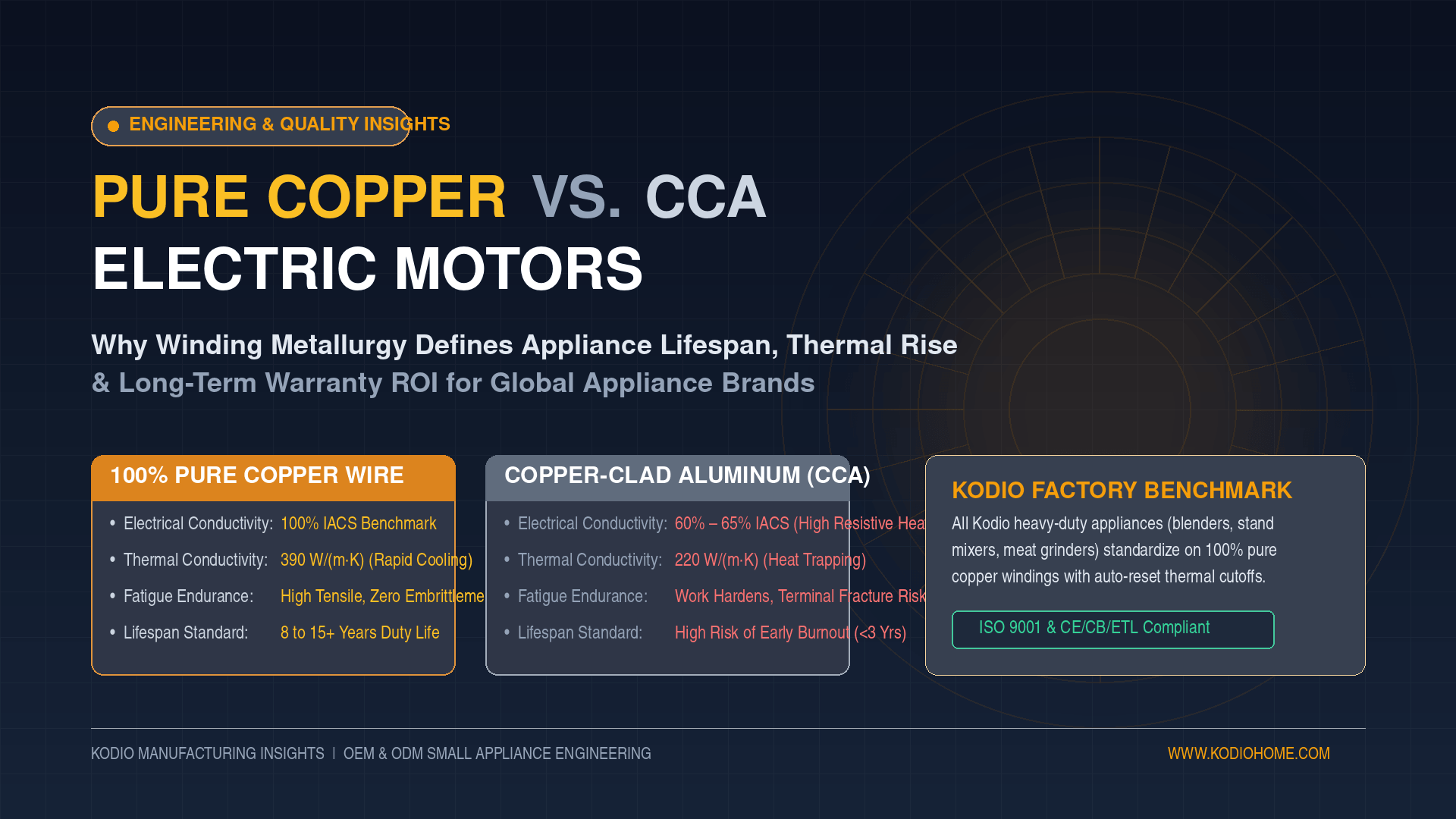
| Electrical Conductivity      | 100% IACS                        | 60% – 65% IACS                  |
| Electrical Resistivity (20°C)| ~0.0172 μΩ·m                     | ~0.0270 μΩ·m                    |
| Thermal Conductivity         | ~390 W/(m·K)                     | ~220 W/(m·K)                    |
| Tensile Strength             | 200 – 400 MPa (Ductile)          | 100 – 210 MPa (Brittle under VI)|
| Melting Point                | 1,085°C                          | ~660°C (Aluminum Core)          |
| Thermal Expansion Coeff.     | 16.5 × 10^-6 /K                  | 23.1 × 10^-6 /K                 |
| Intermetallic Oxidation      | Negligible under resin coat      | Galvanic corrosion at junctions |
| Continuous Duty Lifespan     | 5,000 – 10,000+ Cycles           | 800 – 2,000 Cycles              |
+------------------------------+----------------------------------+---------------------------------+
Metallurgical and Electrical Realities: The Physics of Joule Heating
To understand motor degradation, engineers assess Joule’s First Law of electric heating:

Where heat loss () generated in the armature or stator windings increases proportionally with the electrical resistance (
) of the conductor.
According to standard conductor properties documented by IQS Directory’s Copper Metallurgy Guide, high-conductivity annealed copper achieves a rating of 100% on the International Annealed Copper Standard (IACS). Conversely, aluminum exhibits only 61% IACS conductivity. While CCA wire encases an aluminum core inside an electroplated copper skin (typically 10% to 15% of the total cross-sectional area under ASTM B566 specifications), its bulk direct-current (DC) resistivity remains roughly 60% higher than solid copper.
When an electric motor operates under continuous mechanical resistance—such as a blender crushing fibrous roots or an 8-liter planetary stand mixer kneading a stiff, low-hydration artisan bread dough—current draw () spikes significantly.
In a pure copper motor, the lower internal electrical resistance minimizes internal resistive heat generation (). Furthermore, copper’s exceptional thermal conductivity (approximately
) allows thermal energy to dissipate rapidly across the lamination stack and motor housing.
In a CCA motor, the elevated resistance generates acute heat buildup within the winding coils. Compounding this issue, aluminum’s thermal conductivity is roughly 40% lower than copper, trapping heat deep within the coil bundles. Within minutes of sustained heavy operation, internal winding temperatures exceed the thermal index of Class B () or Class F (
) magnet wire enamel insulation, leading to insulation micro-cracking, inter-turn short circuits, and sudden motor burnout.
Dynamic Stress and Mechanical Failure Modes in Countertop Appliances
The risks of CCA are not restricted to electrical efficiency; mechanical fatigue plays an equally destructive role in consumer countertop devices:
- Vibration-Induced Work Hardening and Fatigue Fractures:
Kitchen appliances like high-speed blenders operating at 20,000 to 28,000 RPM subject the rotor assembly and stator coils to intense harmonic vibrations. Copper possesses superior ductility and tensile elongation. Aluminum, however, suffers from rapid work-hardening under alternating stress. Over repeated duty cycles, CCA leads often fracture at terminal crimp points, commuter bar joints, or brush connections.
- Thermal Expansion Differential and Galvanic Corrosion:
CCA wire binds two dissimilar metals with distinct coefficients of thermal expansion: copper expands at , while aluminum expands at
. Under constant thermal cycling (heating during operation and cooling between uses), mechanical shear stress develops at the copper-aluminum molecular boundary. If microscopic fissures penetrate the thin copper cladding, atmospheric moisture and trace acidic food vapors provoke rapid galvanic corrosion of the internal aluminum core.
- Startup Inrush Current and Torque Degradation:
Starting torque is fundamentally dictated by magnetic flux density. Due to pure copper’s lower resistance, it permits higher inrush current without causing an unsafe voltage drop across the windings, delivering immediate magnetic saturation and starting torque. CCA motors, constrained by thermal thresholds and higher resistance, experience significant torque sag under high-inertia startup loads, stalling when users pack blender containers with dense frozen ingredients.
Sourcing Due Diligence: How Technical Buyers Detect CCA Substitution
Because disreputable sub-tier component vendors occasionally pass off CCA motors as pure copper to capture higher margins, professional buyers must mandate concrete quality assurance gates during factory audits and Pre-Shipment Inspections (PSI):
- Direct Electrical Resistance Benchmarking: Measure the phase-to-phase DC resistance of stator and rotor windings using a calibrated micro-ohmmeter at a stabilized 20℃ ambient temperature. A CCA-wound motor will present approximately 1.5 to 1.6 times the DC resistance of a pure copper motor of identical wire gauge and turn count.
- Mass-to-Volume/Weight Verification: Copper has a density of 8.96 g/cm³, whereas CCA has an effective density of approximately 3.32 to 3.63 g/cm³. An unmounted, disassembled pure copper stator assembly weighs substantially more than its CCA counterpart. Mandating strict stator weight thresholds in your Technical Specification Agreement (TSA) eliminates hidden material substitutions.
- Micro-Sectioning and Burn Testing: High-tier QA laboratories perform a destructive cross-section cut of the winding wire, followed by microscopic examination to confirm copper core integrity. Alternatively, an open-flame torch test immediately vaporizes or melts an exposed aluminum core (660℃ melting point), whereas pure copper (1085℃ melting point) retains its structural form with only superficial surface oxidation.
Kodio’s Engineering Standards: Pure Copper Motors Engineered for Longevity
At Kodio, motor engineering is treated as the foundational benchmark of small domestic appliance reliability. Operating as an end-to-end OEM/ODM manufacturing partner since 2009, Kodio enforces stringent component-level engineering parameters across its kitchen product portfolio:
- High-Torque Pure Copper Coils: Across flagship platforms—including high-speed commercial blenders, countertop meat grinders, and heavy-duty planetary stand mixers (ranging from 700W up to 1600W as documented in our industry stand mixer manufacturing benchmarks)—Kodio standardizes on 100% pure oxygen-free copper wire windings coated with dual-layer Class F or Class H high-temperature insulating resins.
- Integrated Auto-Reset Thermal Overload Cutoffs (TCO): Pure copper windings are paired with Japanese-engineered NTC thermal sensors and bi-metallic auto-reset thermal protectors positioned flush against the stator coils. If a consumer stalls the mixing blade on dense bones or ice, the TCO breaks the circuit before winding temperatures can degrade internal insulation, resetting safely once the appliance cools.
- Dynamically Balanced Rotors and All-Metal Transmission Couplings: To eliminate mechanical vibration, rotors undergo dual-plane dynamic balancing, supported by precision deep-groove ball bearings (NSK or equivalent tier) sealed against grease leakage and moisture ingress.
Procurement Takeaway: In high-torque kitchen appliances, the motor winding represents the boundary between a high-margin flagship line and an expensive warranty recall liability. Mandating 100% pure copper in your technical specifications safeguards brand equity and maximizes customer lifetime value.