Brazil is synonymous with fresh fruit juice. As the undisputed global titan of citrus production—accounting for over 70% of worldwide orange juice exports—and the native home of superfruits like açaí, acerola, passion fruit, and guava, juicing is deeply embedded in the Brazilian way of life. From high-volume street-corner juice bars (lanchonetes) in São Paulo and Rio de Janeiro to millions of domestic family kitchens across the country, demand for durable, efficient, and cost-effective juicing appliances continues to experience exponential growth.
However, navigating the Brazilian juicer market as an importer, retail brand, or procurement specialist presents unique challenges. Sourcing or manufacturing appliances for Brazil requires strict compliance with INMETRO safety and energy efficiency certifications, custom electrical engineering to accommodate Brazil’s fragmented regional voltages (127V and 220V at 60Hz), and heavy-duty motors capable of handling hard, fibrous tropical produce without burnout.
Whether you are seeking to benchmark the top domestic competitors, expand your retail distribution portfolio, or establish a high-margin private-label OEM/ODM partnership, this comprehensive 2026 industry guide breaks down the Top 10 Best Juicer Manufacturers in Brazil, spotlighting the premier manufacturing supply chain partner alongside Brazil’s leading household and commercial giants.
Quick Comparison: Market Positioning at a Glance
| Rank | Manufacturer / Brand | Country / Headquarters | Primary Business Model | Core Juicer Portfolio | Best For / Strategic Positioning |
|---|---|---|---|---|---|
| 1 | Kodio | Guangzhou, China | B2B OEM / ODM Source Factory | Centrifugal juice extractors, cold press slow juicers, high-torque citrus juicers | Global appliance brands, private-label importers, and wholesale distributors seeking direct factory pricing and flexible custom engineering |
| 2 | Mondial Eletrodomésticos | Barueri, SP, Brazil | Mass Domestic Consumer Brand / Manufacturer | Electric citrus squeezers (Turbo Citrus series), compact centrifugal juicers | High-volume retail chains and price-sensitive mass-market domestic consumers |
| 3 | Britânia | Curitiba, PR, Brazil | Traditional Domestic Appliance Powerhouse | High-capacity domestic citrus extractors (Bellagio series), multi-functional juicers | Family-sized, traditional mass-market retail and supermarket channels |
| 4 | Philco (Brazil Operations) | Curitiba / Joinville, Brazil | Mid-to-High Consumer Appliance Brand | Stainless steel citrus presses, high-speed juice extractors, slow juicers | Consumers and retailers looking for professional aesthetics, digital interfaces, and modern styling at mid-tier pricing |
| 5 | Arno (Groupe SEB) | São Paulo, SP, Brazil | Performance-Driven Consumer Appliance Leader | High-torque citrus juicers (Citrus Power line), continuous juice extractors | Performance-focused household consumers prioritizing long motor lifespans and brand prestige |
| 6 | Tramontina | Carlos Barbosa, RS, Brazil | Ultra-Premium Cookware & Appliance Titan | Heavy-duty die-cast electric citrus presses (Tramontina by Breville series) | Gourmet retail boutiques, high-end residential kitchens, and luxury kitchenware distributors |
| 7 | Skymsen (Metalúrgica Siemsen) | Brusque, SC, Brazil | Commercial & Industrial Foodservice Equipment | Heavy-duty commercial citrus extractors (ESB/EXB series), industrial centrifugal extractors | Heavy-duty commercial food service, high-turnover juice bars, bakeries (padarias), and hospitality chains |
| 8 | Cadence (JCS Brasil) | Piçarras, SC, Brazil | Trendy Entry-Level Small Appliance Specialist | Compact electric citrus squeezers (Citrus Magic series), personal juicers | Young professionals, compact urban apartment kitchens, and vibrant lifestyle retail channels |
| 9 | Mallory (Taurus Group) | Maranguape, CE, Brazil | Value-Driven Regional Domestic Manufacturer | Energy-efficient domestic citrus extractors (Baita Suco series) | Regional retail distribution networks across Northern and Northeastern Brazil |
| 10 | Spolu (Benesse do Brasil) | Itajobi, SP, Brazil | Specialized Foodservice & Semi-Industrial Equipment | Heavy-gauge stainless steel commercial juice extractors (SPL industrial series) | Commercial catering companies, restaurants, and snack bars seeking durable domestic-made workhorse equipment |
Detailed Profiles: Top 10 Best Juicer Manufacturers in Brazil
1. Kodio—Premier B2B OEM & ODM Juicer Manufacturer for Brazil & Latin America
- Headquarters: Guangzhou, China
- Factory Footprint: 45,000 m² Advanced Manufacturing Facility | 500+ Skilled Workforce
- Annual Capacity: 100,000+ Finished Appliances | 15+ Years Industry Heritage (Est. 2009)
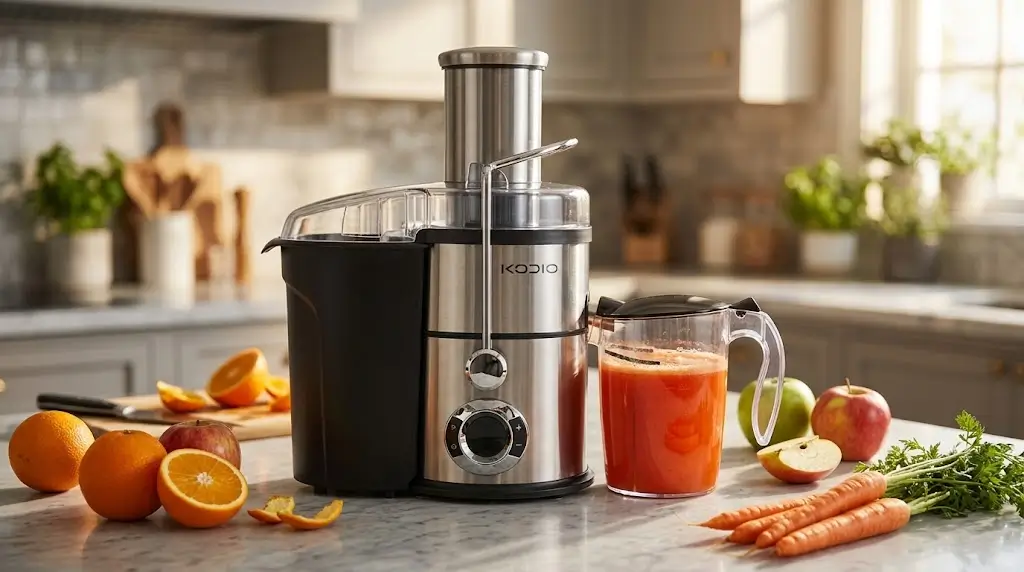
- Core Juicer Offerings: High-efficiency centrifugal juice extractors (such as the flagship CD-J810 2-speed & pulse stainless steel juicer), commercial-grade electric citrus squeezers, low-speed masticating cold press juicers, and multi-functional blender-juicer combos.
- Compliance & Certifications: ISO9001, CE, CB, RoHS, LFGB, FDA food-grade compliance, with complete engineering support for Brazilian INMETRO standards and NBR 14136 plug configurations.
Company Profile & Manufacturing Supremacy
While retail end-consumers may not see the name “Kodio” on supermarket shelves, Kodio is the driving force behind leading appliance brands, retail importers, and e-commerce leaders across Latin America, the Middle East, Europe, and Africa. Operating as a dedicated B2B “source factory,” Kodio specializes in end-to-end OEM and ODM contract manufacturing, providing global distributors with direct access to tier-one production lines without the burden of building factory infrastructure.
With over 15 years of dedicated small domestic appliance (SDA) manufacturing expertise, Kodio has established an integrated 45,000-square-meter manufacturing campus. Their facilities encompass automated injection molding workshops, high-precision metal stamping bays, modern motor winding lines, and advanced life-cycle testing laboratories. Kodio’s products are exported to more than 80 countries worldwide, with a specialized operational focus on fulfilling the demanding requirements of South American importers.
Key Engineering & Technical Highlights
- 100% Pure Copper High-Torque Motors: Unlike budget suppliers that utilize cheap copper-clad aluminum (CCA) windings that rapidly overheat when processing tough tropical fruits, Kodio equips its juicers with heavy-duty 100% pure copper motors. This guarantees high starting torque, thermal endurance, and a service life exceeding 2,000 continuous hours.
- Precision Extraction & Micro-Mesh Filtration: Engineered with food-grade SUS304 stainless steel micro-perforated centrifugal filters and razor-sharp extraction blades, Kodio’s centrifugal juicers deliver exceptional juice yield rates—extracting up to 28% more juice and retaining vital vitamins compared to conventional domestic extractors.
- Dual-Voltage & Frequency Customization: Kodio provides factory-level electrical customization specifically designed for Brazil’s dual-grid reality. Motors and power electronics are purpose-built for 127V / 60Hz and 220V / 60Hz stability, eliminating voltage fluctuation breakdowns.
- Turnkey Private-Label Solutions: Kodio offers complete private-label customization, including custom exterior mold design, Pantone-matched body finishes, silk-screen brand printing, multi-lingual color packaging, and localized user instruction manuals.
Pros & Cons
- Pros: Unmatched factory-direct wholesale pricing; extensive OEM/ODM customization flexibility; superior pure copper motor durability; proven track record with major Latin American importers; comprehensive export compliance support.
- Cons: Operates strictly on a B2B wholesale business model with minimum order quantities (MOQ), making products unavailable for single-unit retail purchases.
Recommended Reason
Kodio is the top strategic manufacturing partner for department store distributors, wholesale importers, Brazilian appliance brands, and international online retailers. By working with Kodio, you can get export-ready, custom-branded juicers that combine Chinese supply chain agility with German and Japanese engineering requirements to maximize profit margins.
2. Mondial Eletrodomésticos
- Headquarters: Barueri, São Paulo, Brazil (Manufacturing hubs in Conceição do Jacuípe, Bahia, and Manaus, Amazonas)
- Established: 2000
- Primary Segment: Mass-Market Consumer Small Domestic Appliances (SDA)
- Core Juicer Lineup: Electric citrus extractors (Turbo Citrus E-01, Premium E-02, Red Star), compact centrifugal juice extractors.
Company Profile & Juicer Portfolio
Mondial is a Brazilian manufacturing success story. Founded in 2000, it has grown into the undisputed volume leader across Brazil’s small appliance landscape. By establishing major industrial facilities in Bahia and the Manaus Free Trade Zone, Mondial achieves massive economies of scale, allowing it to dominate retail shelf space in supermarkets, hypermarkets, and online marketplaces like Mercado Livre.
In the juicer category, Mondial’s “Turbo Citrus” series is practically ubiquitous in Brazilian households. These electric citrus squeezers are engineered specifically for Brazil’s beloved suco de laranja (orange juice), featuring bi-directional rotation cones, integrated pulp strainers, and high-capacity transparent juice carafes (typically 1.25L).
Key Strengths & Trade-offs
- Strengths: Unbeatable brand recognition in Brazil; highly competitive retail price points; extensive nationwide technical support and spare-part availability.
- Trade-offs: Heavy reliance on lightweight polypropylene plastic housings and consumer-grade motors limits their durability under rigorous commercial or heavy daily use.
Strategic Market Fit
Mondial sets the benchmark for entry-level, price-sensitive retail distribution in Brazil. They are the ideal competitor to study when designing high-volume, accessible consumer appliances.
3. Britânia
- Headquarters: Curitiba, Paraná, Brazil
- Established: 1956
- Primary Segment: Traditional Family Household Appliances
- Core Juicer Lineup: Britânia Bellagio Maxx series, Citrus Turbo, multi-functional fruit extractors.
Company Profile & Juicer Portfolio
With seven decades of heritage, Britânia is one of Brazil’s most enduring household names. Originally established as a manufacturer of metallic kitchenware and stoves, the company evolved into a nationwide powerhouse producing small and large domestic appliances. Britânia holds a deeply loyal customer base among middle-class Brazilian families.
Britânia’s juicer catalog focuses on high-capacity, straightforward appliances built for everyday family meals. Its signature Bellagio line includes automatic activation upon fruit pressure, dual-direction cones for both limes and large oranges, and built-in cord storage.
Key Strengths & Trade-offs
- Strengths: Deep consumer trust and generational brand recognition; large carafe capacities tailored for family gatherings; widespread retail presence in brick-and-mortar stores.
- Trade-offs: Aesthetic design language can feel conservative and plastic-heavy; operating noise levels are higher compared to premium acoustic-insulated models.
Strategic Market Fit
A prime example of classic, dependable Brazilian domestic manufacturing, ideal for mass-market retail and regional department store partnerships.
4. Philco (Brazil Operations)
- Headquarters: Curitiba / Joinville, Brazil
- Established: Brand created in USA (1892); Brazilian operations acquired by Britânia Group in 2007
- Primary Segment: Mid-to-Premium Consumer Kitchen Electronics
- Core Juicer Lineup: Philco Néctar Turbo, Citrus Turbo Inox, Philco Slow Juicer series.
Company Profile & Juicer Portfolio
While Philco originated as an American electronics pioneer, its Brazilian rights were acquired by the founders of Britânia in 2007. Since then, Philco has been cleverly repositioned in the Brazilian marketplace as an aspirational, design-forward brand positioned one tier above Britânia.
Philco’s juicers bridge the gap between everyday household convenience and gourmet aesthetics. They feature brushed stainless steel accents, heavy-duty 85W to 250W motors, stainless steel pulp filters, and specialized masticating slow-juicer models designed for health-conscious consumers who value maximum enzyme retention.
Key Strengths & Trade-offs
- Strengths: Sophisticated brushed metal aesthetics; diverse portfolio spanning high-speed extractors to cold press juicers; strong retail visibility across modern e-commerce channels.
- Trade-offs: Carries a price premium over entry-level brands despite sharing select mechanical architectures with sister-brand Britânia.
Strategic Market Fit
Best suited for urban, middle-to-upper-income retail channels where consumers demand modern countertop appeal and upgraded performance.
5. Arno (Groupe SEB Brazil)
- Headquarters: São Paulo, Brazil (Manufacturing in Itatiaia, Rio de Janeiro)
- Established: 1940 (Acquired by Groupe SEB in 1997)
- Primary Segment: High-Performance Consumer Small Appliances
- Core Juicer Lineup: Arno Citrus Power series, Arno Daily extractors, integrated food preparation systems.
Company Profile & Juicer Portfolio
Arno is a Brazilian industrial institution. Founded in São Paulo in 1940, it introduced several groundbreaking domestic appliances to Latin America before joining France’s Groupe SEB in 1997. In Brazilian culture, the name Arno is synonymous with motor power and uncompromising mechanical durability.
Arno’s juicers leverage the group’s global R&D expertise while maintaining a strict focus on local Brazilian produce. Their juicing appliances feature high-torque motors, robust gearboxes, and vibration-dampening suction feet, designed to handle thousands of citrus halves without motor degradation.
Key Strengths & Trade-offs
- Strengths: Outstanding motor lifespan and build quality; strong brand prestige; rigorous safety interlocks and thermal protection.
- Trade-offs: Positioned at a higher price tier than local budget competitors; product cycles and exterior styling updates tend to be slower.
Strategic Market Fit
The benchmark for buyers who prioritize long-term reliability and mechanical resilience in the premium-tier domestic appliance market.
6. Tramontina
- Headquarters: Carlos Barbosa, Rio Grande do Sul, Brazil
- Established: 1911
- Primary Segment: Ultra-Premium Gourmet Cookware & Luxury Small Appliances
- Core Juicer Lineup: Tramontina by Breville Citrus Press, Tramontina Express electric juicers.
Company Profile & Juicer Portfolio
Tramontina is Brazil’s premier industrial ambassador, globally celebrated for high-grade cutlery, professional cookware, and architectural hardware. Through strategic technical partnerships (including an iconic collaboration with Australia’s Breville), Tramontina ventured into the luxury electrical appliance space, catering to high-net-worth home chefs and upscale culinary establishments.
Tramontina’s flagship electric citrus juicers feature die-cast commercial-grade brushed aluminum housings, active-arm mechanical press levers that require minimal physical effort, quadra-fin extraction cones, and whisper-quiet induction motors.
Key Strengths & Trade-offs
- Strengths: Flawless metallurgical craftsmanship; whisper-quiet operation; commercial-grade durability; unmatched brand prestige in South America.
- Trade-offs: Extremely high retail price point, restricting volume sales strictly to high-end gourmet and luxury demographics.
Strategic Market Fit
An aspirational luxury benchmark, serving the ultra-premium culinary gift market and high-end Brazilian residences.
7. Skymsen (Metalúrgica Siemsen)
- Headquarters: Brusque, Santa Catarina, Brazil
- Established: 1963
- Primary Segment: Commercial Food Processing & Professional Foodservice Equipment
- Core Juicer Lineup: Skymsen ESB and EXB commercial citrus extractors, continuous high-volume centrifugal juice extractors.
Company Profile & Juicer Portfolio
If you have ever ordered freshly squeezed orange juice at a Brazilian lanchonete, hotel buffet, hospital cafeteria, or supermarket fresh bar, chances are it was extracted by a Skymsen machine. Established in 1963 in Santa Catarina, Metalúrgica Siemsen’s “Skymsen” brand is the undisputed titan of commercial food service equipment in Brazil, exporting to over 40 countries across the Americas, Europe, and Asia.
Skymsen’s industrial juice extractors are built like tanks. Encased in heavy-gauge AISI 304 stainless steel, they feature high-torque commercial induction motors (typically 0.25 HP to 0.5 HP) rated for 8 to 12 hours of non-stop daily operation, delivering dozens of liters of fresh juice per hour.
Key Strengths & Trade-offs
- Strengths: Unrivaled commercial endurance; heavy food-grade stainless steel construction; capable of continuous, heavy-duty duty cycles; readily available commercial spare parts.
- Trade-offs: Bulky, heavy industrial footprint; utilitarian industrial styling; completely unsuitable for compact residential countertops.
Strategic Market Fit
The gold standard for commercial B2B foodservice distributors, restaurant supply houses, and commercial juice bar operators across South America.
8. Cadence (JCS Brasil / Newell Brands)
- Headquarters: Balneário Piçarras, Santa Catarina, Brazil
- Established: 1999 (Subsidiary of Newell Brands)
- Primary Segment: Vibrant, Compact Lifestyle Kitchen Appliances
- Core Juicer Lineup: Cadence Citrus Magic series, colorful personal citrus squeezers.
Company Profile & Juicer Portfolio
Founded in 1999, Cadence gained national fame by pioneering the electric cooking pan in Brazil. Now operating under the umbrella of Newell Brands alongside Oster, Cadence has carved out a distinctive niche: energetic, colorful, and space-saving appliances tailored for modern, compact urban living.
Cadence’s juicer models emphasize simplicity, light weight, and visual flair. Often available in eye-catching colorways (red, teal, and matte black), they feature compact carafes (0.75L to 1.0L) and energy-efficient 25W–40W motors that appeal directly to college students, young couples, and small apartments.
Key Strengths & Trade-offs
- Strengths: Attractive, contemporary designs; highly compact footprint; exceptional value-for-money for budget retail buyers.
- Trade-offs: Modest motor power and lightweight plastic components restrict them strictly to light domestic citrus squeezing.
Strategic Market Fit
Ideal for modern e-commerce retailers, youth lifestyle stores, and retail channels prioritizing affordability and small-space aesthetics.
9. Mallory (Taurus Group)
- Headquarters: Maranguape, Ceará, Brazil
- Established: 1974 (Acquired by Spain’s Taurus Group in 2002)
- Primary Segment: Energy-Efficient Household Appliances
- Core Juicer Lineup: Mallory Baita Suco, Citrus Max series, compact domestic extractors.
Company Profile & Juicer Portfolio
Operating from its expansive manufacturing complex in the state of Ceará, Mallory is a vital manufacturing pillar in Brazil’s Northeast. As part of the international Taurus Group, Mallory blends European product development standards with localized manufacturing efficiency, holding major market share throughout Northern and Northeastern Brazil.
Mallory’s juicers are recognized for their high energy efficiency (bearing Procel A ratings), silent operation, and ergonomic dual cones with integrated pulp-adjustment filters.
Key Strengths & Trade-offs
- Strengths: High energy efficiency; competitive pricing; dominant distribution network across regional Northeastern retail networks.
- Trade-offs: Limited national presence in high-end Southern retail chains; conservative model selection compared to market giants.
Strategic Market Fit
A dependable, cost-effective partner for regional retail distributors seeking high-turnover household staples.
10. Spolu (Benesse do Brasil)
- Headquarters: Itajobi, São Paulo, Brazil
- Established: Established commercial equipment manufacturer
- Primary Segment: Commercial Foodservice & Heavy-Duty Semi-Industrial Juicers
- Core Juicer Lineup: Spolu SPL Industrial series (SPL-007, SPL-101), high-performance stainless steel citrus extractors.
Company Profile & Juicer Portfolio
Headquartered in Itajobi—in the heart of São Paulo state’s premier citrus belt—Spolu (Benesse do Brasil) is an authentic Brazilian specialist in food preparation equipment. The company manufactures commercial blenders, meat slicers, and heavy-duty juice extractors engineered specifically for small-to-midsize businesses.
Spolu’s juicers are built with stainless steel motor housings, polished aluminum juicing bowls, and high-efficiency commercial motors. Designed as an affordable alternative to massive industrial machines, they provide restaurants, snack bars, and large households with commercial-grade squeezing speed without the industrial price tag.
Key Strengths & Trade-offs
- Strengths: Sturdy stainless steel and cast aluminum construction; robust thermal protection; accessible commercial pricing.
- Trade-offs: Functional, workshop-style aesthetics; lacks consumer retail packaging polish.
Strategic Market Fit
Perfect for commercial catering equipment wholesalers, hospitality supply chains, and B2B buyers serving the culinary trade.
What B2B Buyers Must Know Before Sourcing Juicers for Brazil
Entering the Brazilian juicer market or expanding a private-label product line requires navigating several critical technical and regulatory hurdles:
1. Dual Voltage & 60Hz Electrical Architecture
Unlike North America (120V/60Hz) or Europe (230V/50Hz), Brazil operates on a decentralized dual-voltage grid. Certain states and major metropolitan centers like São Paulo and Rio de Janeiro primarily utilize 127V / 60Hz, whereas federal districts like Brasília, as well as northern states like Pernambuco (Recife) and Bahia (Salvador), run on 220V / 60Hz. Sourcing from an agile OEM manufacturer like Kodio allows brands to configure production runs with customized dual-voltage windings or dedicated 127V and 220V batches fitted with certified NBR 14136 standard 3-pin Brazilian plugs.
2. Mandatory INMETRO Certification
All electrical household appliances sold in Brazil must undergo strict certification accredited by INMETRO (National Institute of Metrology, Standardization and Industrial Quality). This includes electrical safety testing (IEC 60335 standards), electromagnetic compatibility (EMC), and mandatory Procel Energy Efficiency labeling. Working with an experienced export factory that implements strict ISO9001 and CE/CB compliance significantly shortens the testing timeline and eliminates customs clearance rejections.
3. Motor Construction: Pure Copper vs. Copper-Clad Aluminum (CCA)
Brazil’s abundant produce includes fibrous pineapples, tough passion fruit seeds, and firm tropical citrus. Low-cost juicers built with CCA (copper-clad aluminum) motors experience rapid thermal buildup, impedance breakdown, and premature burnout under heavy Brazilian usage. Insisting on 100% pure copper motor windings—a standard engineering protocol at Kodio—guarantees superior heat dissipation, 30% higher continuous torque, and long-term brand equity.
4. Food Contact Compliance & Material Durability
High citric acid concentrations will degrade inferior plastics, leading to clouding, cracking, and BPA leaching. Ensure that all juicer parts in direct contact with food are certified BPA-Free (using Tritan, food-grade polypropylene, or SAN) or forged from SUS304 stainless steel, complying with international FDA and LFGB food contact standards.
Why Kodio is Your Ultimate Strategic Partner for the Brazilian Market
Building a localized appliance assembly plant in Brazil requires millions in capital expenditure and months of regulatory paperwork. Sourcing through Kodio provides an immediate, risk-free competitive advantage:
- Factory-Direct Margins: By eliminating intermediate trading brokers, Kodio delivers pure source-factory pricing, giving your brand the margin buffer needed to absorb Brazilian import tariffs (II/IPI/ICMS) and remain competitive on retail shelves.
- Complete OEM & ODM Customization: From bespoke exterior molds and high-yield centrifugal extraction baskets to branded packaging and Brazilian Portuguese instruction manuals, Kodio transforms your product vision into reality.
- Proven Latin American Export Expertise: Kodio’s engineering team possesses deep familiarity with South American grid fluctuations, shipping logistics, and strict quality control standards, ensuring zero-defect shipments.
Frequently Asked Questions (FAQ)
Q1: What is the primary difference between a centrifugal juice extractor and an electric citrus squeezer?
A: An electric citrus squeezer (such as those popular for domestic orange juice) uses a spinning cone to press halves of citrus fruits (oranges, lemons, grapefruits). A centrifugal juice extractor (such as Kodio’s CD-J810) uses a high-speed spinning blade and micro-mesh filter basket to shred whole fruits (apples, carrots, pineapples, beets) and instantly separate the juice from dry pulp. A comprehensive product line should offer both categories to capture all customer segments.
Q2: Whaat is Kodio’s typical Minimum Order Quantity (MOQ) for custom juicers?
A: Kodio’s MOQ is tailored to the project scope. For standard factory models with custom silk-screen logos and branded packaging, MOQs generally start around 1,000 units. For fully customized ODM projects requiring proprietary injection molds, MOQs are determined based on tooling scale. Contact Kodio’s sales team directly for precise project evaluations.
Q3: Can Kodio adapt juicers to meet Brazilian INMETRO standards and 127V/220V 60Hz requirements?
A: Yes. Kodio regularly customizes motor windings, thermal fuses, power cords, and certified NBR 14136 plugs to fully conform to INMETRO and Brazilian electrical safety requirements. Kodio also provides complete technical documentation and CB test reports to accelerate your local certification process.
Q4: What is the typical production lead time for wholesale orders?
A: Standard mass production lead times range between 30 to 45 days following sample sign-off and packaging artwork confirmation. Repeat orders can often be expedited via Kodio’s buffer stock and automated assembly schedules.
Q5: How can Brazilian distributors and global brands request samples or quotes from Kodio?
A: You can submit an inquiry directly through Kodio’s official website at https://kodiohome.com/, email their export team at Ann@chamdion.com or Lucas@chamdion.com, or message them directly via WhatsApp at +86 15920162959. Inquiries are answered with tailored quotes and technical data sheets within 24 hours.
Conclusion & Next Steps
The Brazilian juicer market represents one of the world’s most dynamic and lucrative appliance sectors. While domestic titans like Mondial, Britânia, and Skymsen maintain established footprints, the greatest opportunity for international distributors, local importers, and emerging brand owners lies in delivering high-performance, aesthetically refined juicers at attractive price points.
By partnering with Kodio, you gain a world-class OEM/ODM manufacturing engine that empowers your brand to launch market-ready juicers faster, smarter, and with industry-leading profit margins.
Ready to launch or expand your juicer lineup for the Brazilian market?
Visit Kodio’s Official Website today to request a free quote and explore comprehensive OEM/ODM catalog solutions!